What is agentic breach management?
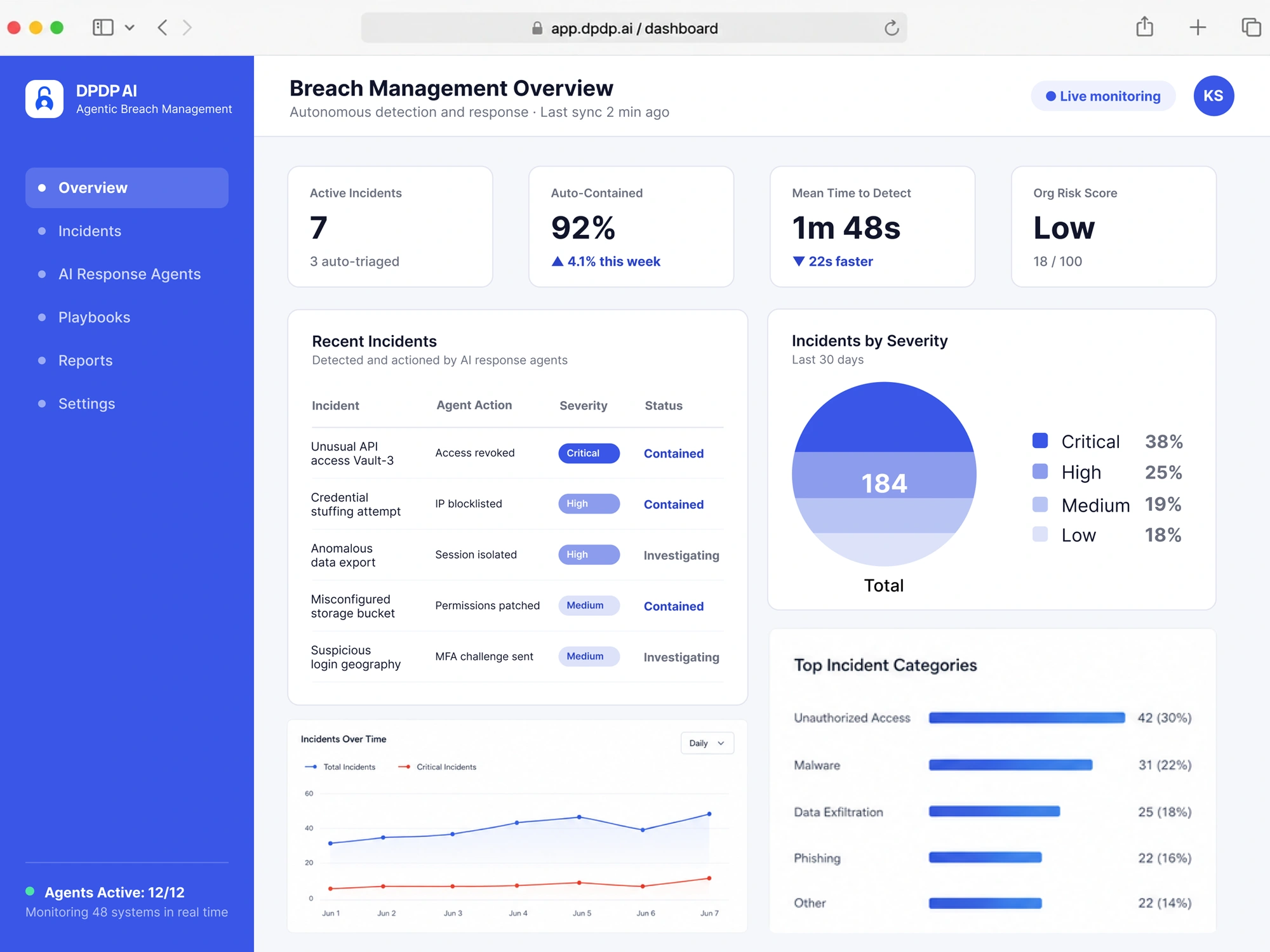
Agentic Breach Management Solution is an AI-driven incident response management approach to handling data breaches. Instead of only sending alerts, autonomous AI agents detect a breach, assess its impact, contain the incident, prepare regulatory notifications, and preserve evidence automatically. Unlike traditional SIEM tools that rely on security teams to investigate and respond, Agentic Breach Management acts immediately. This helps organisations respond faster and meet regulatory timelines, including the DPDP Act's 72-hour breach notification requirement.
What is the breach notification deadline under the DPDP Act 2023?
Under Section 8(6) of the DPDP Act 2023 and Rule 7 of the DPDP Rules 2025, organisations must notify the Data Protection Board of India (DPBI) without undue delay after becoming aware of a personal data breach. A detailed report must be submitted within 72 hours. Organisations are also required to notify every affected Data Principal. Failure to meet these obligations can result in penalties of up to Rs 200 crore. Separately, CERT-In requires certain cybersecurity incidents to be reported within 6 hours of detection.
How is agentic breach management different from traditional SIEM or incident response tools?
Traditional SIEM platforms and incident management tools detect suspicious activity and generate alerts, but the response process still depends on security teams. They must investigate the incident, assess its impact, contain the breach, prepare notifications, and complete regulatory reporting.
Agentic Breach Management goes a step further. AI agents automatically assess the scope of the breach, initiate containment, prepare notifications for the Data Protection Board and CERT-In, and support regulatory reporting within hours instead of waiting for manual action.
Which regulators does the platform notify automatically during a breach?
The platform supports regulatory reporting for multiple authorities from a single breach event. It can prepare notifications for the Data Protection Board of India (DPB) under the DPDP Act, CERT-In under the IT Rules 2022, and sector-specific regulators such as RBI, SEBI, and IRDAI, where applicable. For organisations operating globally, it also supports reporting requirements for international regulators, including GDPR supervisory authorities, Singapore's PDPC, Australia's OAIC, US state authorities, and China's Cyberspace Administration, reducing duplicate reporting efforts.
Can the AI agent notify affected Data Principals in Indian languages?
Yes. The Data Principal Notification Engine can send breach notifications through email, SMS, and in-app notifications in all 22 officially recognised Indian languages, including Hindi, Tamil, Telugu, Marathi, Bengali, Kannada, and Gujarati. It also records proof of delivery for every notification, helping organisations maintain an audit trail while meeting Rule 7's requirement to inform affected individuals in a concise, clear and plain manner.
What are the penalties for failing to notify a breach under the DPDP Act?
The DPDP Act 2023 allows penalties of up to Rs 200 crore for failing to notify the Data Protection Board or affected Data Principals about a personal data breach under Section 8(6). A separate penalty of up to Rs 250 crore may apply under Section 8(5) for failing to implement reasonable security safeguards that contributed to the breach. Depending on the circumstances, these penalties may apply separately for the same incident.
How does the system integrate with our existing security stack?
The platform integrates with leading SIEM platforms such as Splunk, Microsoft Sentinel, and IBM QRadar, as well as cloud logging services including AWS CloudTrail, Azure Monitor, and Google Cloud Audit Logs. Most integrations can be completed in a few hours using pre-built connectors, allowing you to use it alongside your existing security infrastructure instead of replacing it.
What evidence does the system collect and preserve during a breach?
Once a breach is detected, the Forensic Evidence Agent automatically captures and preserves important evidence. This includes the breach timeline, suspicious access records, affected data categories, containment actions with timestamps, regulatory notifications and acknowledgements, and a complete record of AI-driven decisions. All evidence is cryptographically protected and stored in a tamper-proof format, making it available for Data Protection Board investigations, legal proceedings, audits, or cyber insurance claims.