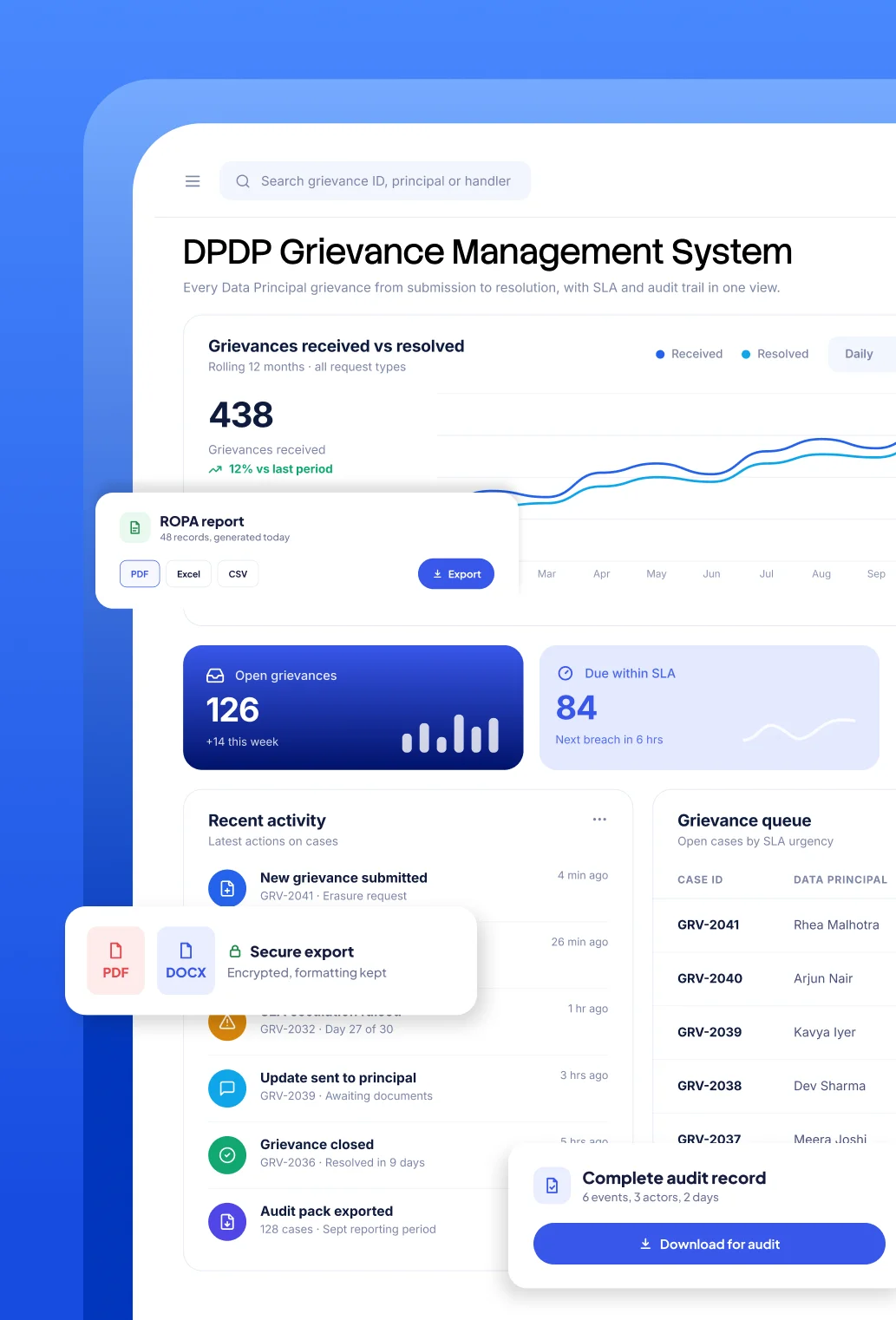
Locate the personal data your factories hold
Manufacturer data sits in HR, ERP, MES, access control and CRM systems across different sites. DPDP.ai finds it, labels it and maps it to its system, owner, purpose and retention period.
Manufacturers hold a huge volume of personal data. This data includes worker attendance, CCTV footage, dealer lists and readings from connected products. Under the DPDP Act, the manufacturers are responsible for all of it. DPDP.ai brings consent, individual requests and supplier checks into one system, so every plant stays audit-ready.
Manufacturers are Data Fiduciaries for employees, contract workers, visitors, dealers and customers. Staffing agencies, hosting providers and service partners are Data Processors. DPDP.ai gives you a single platform to carry out those duties across plants and partners.
Manufacturer data sits in HR, ERP, MES, access control and CRM systems across different sites. DPDP.ai finds it, labels it and maps it to its system, owner, purpose and retention period.

Factories use biometric attendance, CCTV and visitor registers, and each one needs a clear notice and a retention period. DPDP.ai provides purpose-based notices in many languages and keeps consent records wherever consent applies.

Consent Manager registration opens on 13 November 2026, and manufacturers must meet the main DPDP duties from 13 May 2027. DPDP.ai's modules let factories begin with consent and expand later.

Personal data is often sent to parent companies, global HR and ERP platforms and overseas partners. DPDP.ai's data flow monitoring shows which data leaves each plant and where it ends up, which makes review easy.

Personal data is shared with staffing agencies, dealers and service partners, so each one needs a risk review and a ROPA entry. DPDP.ai brings this into one place, linking every agency and service partner to its data, so nothing gets missed.

A single violation can bring a penalty of up to ₹250 crore, depending on the duty breached. DPDP.ai reduces it through various controls.
Personal data was never treated as a priority, so it was never mapped by the manufacturers. These are the first gaps they face.
Contact SalesPersonal data may sit in the HR system, shift records in MES, and gate entries in the access system. One person's data ends up in several places making it hard to track or delete.
Attendance machines, cameras and CCTV tools capture data. To keep that data safe, strong safeguards and small retention periods are required.
Contract labour, security staff and agency workers' IDs, bank details and attendance records sit with the vendor. Factories can’t control how the third-parties handle it.
Customer warranty claim, services, or loyalty enrolment is recorded at a dealer or service centre. With these, the personal data is spread across the factory's partners.
Smart products or IoT sensors in equipment may record location, habits or usage patterns. Factories need to generate user data that needs clear purposes and consent.
Employee’s or customer’s personal data are sent overseas, bringing a need to check that these transfers are lawful and secure.
Manufacturing challenge: Personal data scattered over HR, ERP, MES and plant systems
How DPDP.ai solves it: A scan of structured and unstructured sources produces a live map across all sites.
Manufacturing challenge: Biometric and access data stored without firm limits
How DPDP.ai solves it: Classification and retention rules set boundaries and prompt review or deletion.
Manufacturing challenge: CCTV and visitor records collected without proper notice
How DPDP.ai solves it: Notices and consent records sit in one place and are published in several languages.
Manufacturing challenge: Staffing agencies holding worker data
How DPDP.ai solves it: Each agency is reviewed on a schedule against the terms of its processing agreement.
Manufacturing challenge: Dealer and warranty data shared with partners
How DPDP.ai solves it: ROPA processor entries show who receives which data and for what reason.
Manufacturing challenge: Connected products gathering user data
How DPDP.ai solves it: Consent capture links each data stream to a purpose and records the user's decision.
Manufacturing challenge: Group and overseas transfers
How DPDP.ai solves it: Every data element is tagged by location so each transfer can be examined.
Manufacturing challenge: Employee and customer requests
How DPDP.ai solves it: Requests are logged, routed and closed across linked systems.









Compliance, HR and IT teams at manufacturers raise these questions with us most.
Talk to an ExpertStaffing agencies, hosting providers and any service partners working for the manufacturer are Data Processors.
No employee consent is not needed for HR data. Employers are allowed to process major employment data under "legitimate use" or contractual necessity.
Yes, they are. Worker attendance and CCTV footage data are personal data under the DPDP Act.
A single violation can cost a penalty of up to ₹250 crore (depending on what duty was violated).
DPDP.ai brings consent, individual requests and supplier checks into one system. It maps personal data and provides control systems in a single dashboard. It keeps every plant audit-ready.
See how DPDP.ai can pull your plants, dealers and workforce data into one clear compliance view.
By submitting, you agree to our Privacy Policy. We'll only use your details to arrange the demo.