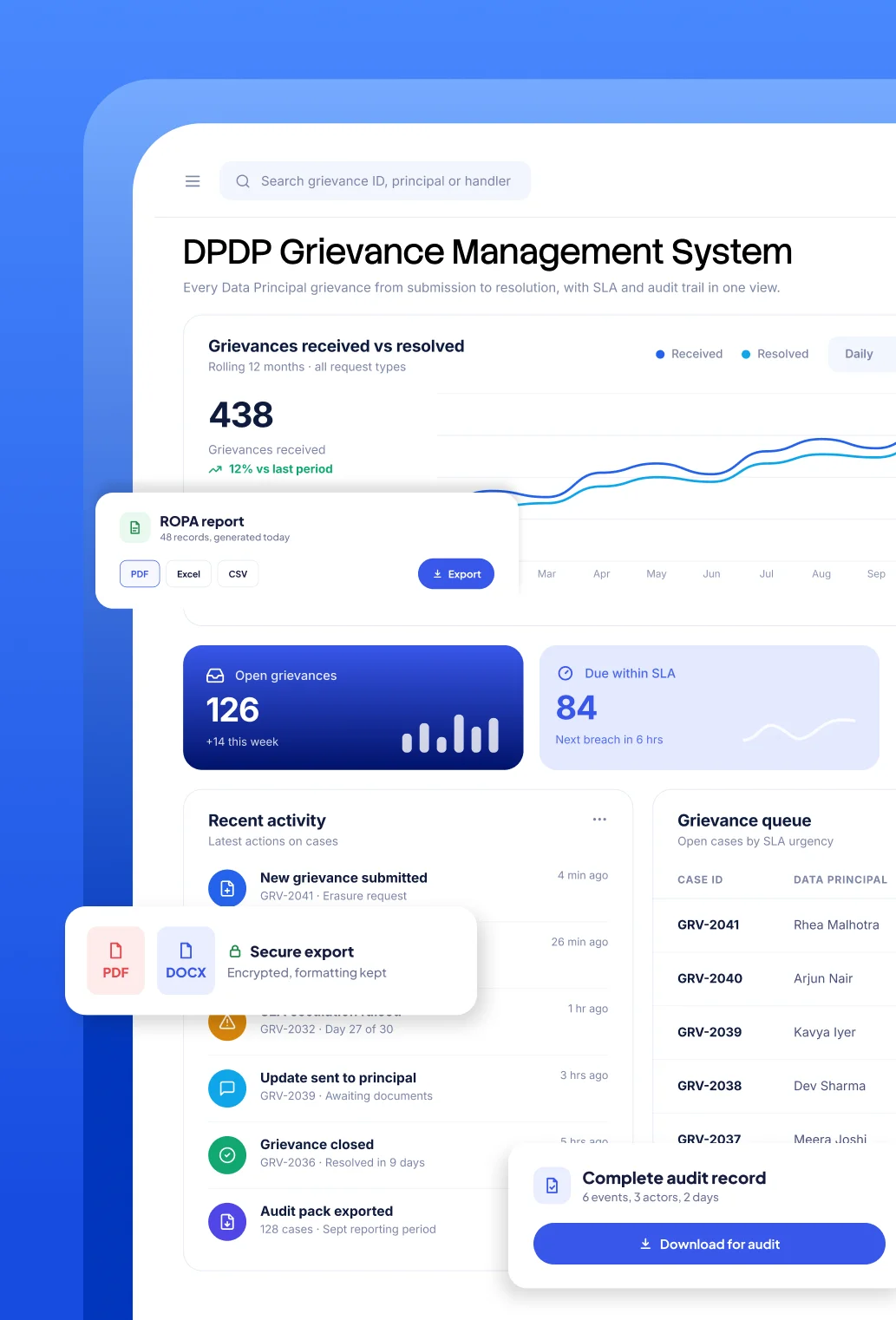
Understand your shopper data
Customer’s accounts, carts, their addresses and orders stay in the store, CRM, warehouse and support tools. DPDP.ai discovers and tags it, then maps each item to its system.
A customer’s search history, delivery addresses, payment details and order logs are personal data under the DPDP Act. DPDP.ai merges consent, cookies, customer requests and seller monitoring into one system, helping your store grow while staying ready for review.
Online retailers and marketplaces are Data Fiduciaries. The couriers, payment gateways, hosting providers and analytics tools used by them are Data Processors. DPDP.ai helps you meet compliance obligations from a singular platform across storefronts, apps and partners.
Customer’s accounts, carts, their addresses and orders stay in the store, CRM, warehouse and support tools. DPDP.ai discovers and tags it, then maps each item to its system.

Fulfilling an order, sending promotions and building profiles each need their own permission. DPDP.ai offers multilingual notices linked to a purpose. It displays the data in a single ledger recording each choice and withdrawal.

Pixels, SDKs and ad tags should not work before a visitor allows them to. Cookie management blocks non-essential ones and stores the decision.

Consent Manager registration opens on 13 November 2026, with main duties starting on 13 May 2027. DPDP.ai's modules (Consent Core, Flow, Control, Govern) let you start with consent and expand later.

Check risks of vendors and show which marketplace seller, courier or payment partner receives which data. DPDP.ai helps you do this in one place, so each partner is linked to the data they handle and nothing gets missed.

Fines could reach up to ₹250 crore per violation, depending on the breach. Businesses with 2 crore or more registered users in India must delete data of long-inactive. DPDP.ai keeps both in check.
As businesses scale with speed and nonstop experiments the privacy risks multiply. This is where teams struggle first.
Contact SalesEcommerce sites use pixels, SDKs and ad tags to track shoppers. Numerous trackers end up collecting data without valid consent.
Pre-ticked boxes and vague pop-ups fall short of free, specific and informed consent.
Customer data moves to sellers, delivery firms, payment partners and support vendors; leaving businesses with more burden of managing them.
Shoppers and customers might ask to see, fix or erase their data whenever they like. The businesses must reply to these requests in a timely manner.
Spotting inactive users and warning them before deletion is hard to do by hand.
Age checks and guardian consent must fit in without spoiling the buying journey for any customer.
E-commerce challenge: Customer data across storefront, CRM, warehouse and support tools
How DPDP.ai solves it: Source scanning delivers a living map of where shopper data sits and moves.
E-commerce challenge: Trackers firing before consent
How DPDP.ai solves it: Cookie controls hold non-essential trackers until the visitor agrees and keep their choice on file.
E-commerce challenge: Order, marketing and profiling consent blended together
How DPDP.ai solves it: A consent engine keeps every purpose apart, with version history and withdrawal.
E-commerce challenge: Personal data reaching sellers, couriers and payment partners
How DPDP.ai solves it: Each partner is reviewed regularly against the terms of its processing agreement.
E-commerce challenge: Large numbers of access, correction and erasure requests
How DPDP.ai solves it: Requests are logged, routed and completed across linked systems on time.
E-commerce challenge: Dormant accounts due for deletion
How DPDP.ai solves it: Inactivity is tracked, triggering advance notices and removal steps.
E-commerce challenge: A breach touching customer and order records
How DPDP.ai solves it: A guided workflow gathers evidence and carries the response through to timely notice.
E-commerce challenge: Notices not written in customers' languages
How DPDP.ai solves it: Notices and consent screens are published in several languages.









Legal, marketing and tech teams at stores and businesses often ask us these questions.
Talk to an ExpertYes it is. Search history, delivery addresses, payment details and order logs are all personal data under the DPDP Act.
Yes. When cookies process personal data and there are checks on that data processing, consent is required.
The Data Fiduciary is responsible for it. If you are an e-commerce business, you are a data fiduciary.
DPDP.ai brings consent, cookie control, customer requests and vendor monitoring into one system. This helps your store grow while staying DPDP compliant.
Large e-commerce entities have to erase data of users who stay inactive for the prescribed period, after warning the inactive users.
Discover how DPDP.ai can bring your storefront, shopper consent and sellers into one clear compliance view.
By submitting, you agree to our Privacy Policy. We'll only use your details to arrange the demo.