Know where policyholder data lives
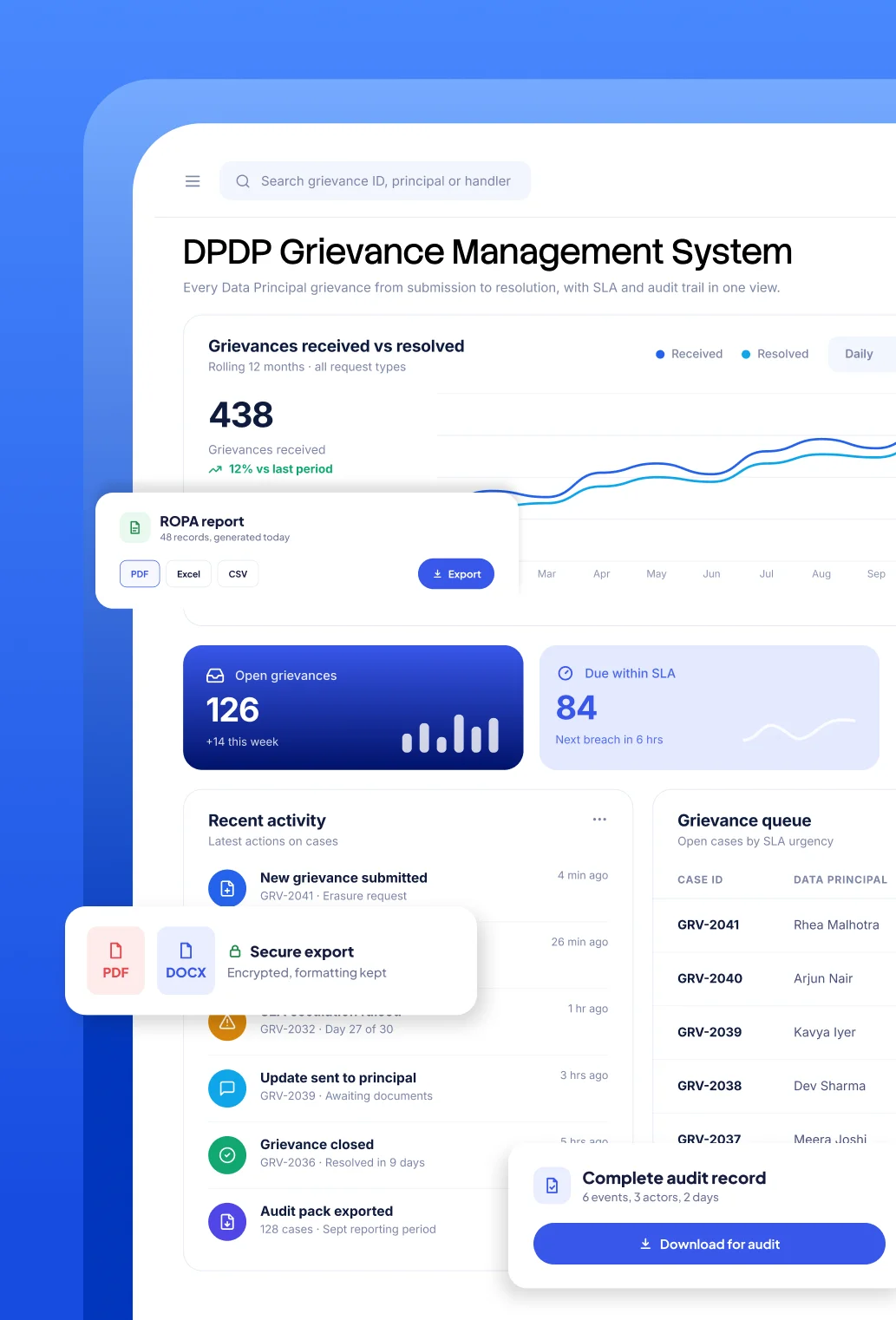
nsurers hold proposals, policies, claims and customer records across policy admin, claims and CRM systems. DPDP.ai finds and labels this data, then maps each item to its system, owner, purpose and retention period.
According to the DPDP Act, personal data in proposal forms, health declarations, claim files and policy records expects insurers to protect it across every product and sales channel. DPDP.ai brings consent, customer requests and intermediary checks into one system, so you stay audit-ready and follow IRDAI guidelines.
An insurer is a Data Fiduciary for policyholder data. TPAs, surveyors, cloud hosts and outsourced service firms working for it are Data Processors. Agents and brokers may fall on either side depending on their role. DPDP.ai lets you handle these duties with ease from one singular platform.
nsurers hold proposals, policies, claims and customer records across policy admin, claims and CRM systems. DPDP.ai finds and labels this data, then maps each item to its system, owner, purpose and retention period.

Agents, banks, aggregators and direct channels all collect consent differently. DPDP.ai keeps one consent record for insurers, with multilingual notices and real-time updates across systems.

Cross-selling to policyholders needs separate consent. DPDP.ai uses purpose-based permissions to keep policy servicing and claims separate from promotions, and records each choice in one place.

Insurers have until 13 May 2027 to meet the main DPDP duties, and Consent Manager registration opens on 13 November 2026. DPDP.ai's modules let insurers start with consent and build up step by step.

Insurers share data with TPAs, brokers, surveyors and partners, and each needs a risk review and a ROPA entry. DPDP.ai links every partner to their respective data in one place.

Each violation can attract up to ₹250 crore, depending on which rule is breached. DPDP.ai shrinks that exposure with controls backed by proof.
Policies run for many years and are sold through a wide network of agents, banks and partners. With this, customer data ends up outside an insurer's own systems. These are the first gaps teams run into.
Contact SalesA customer may hold different policies. So their records are spread across separate systems and lines of business.
Agents, banks, aggregators and direct channels all collect consent differently, so insurers end up with inconsistent consent records.
Health declarations and medical reports passed to TPAs, hospitals and reinsurers adds risk.
Using policy details to pitch other products needs separate, purpose-specific consent from the policyholder.
Records must be kept for years under regulatory rules. Customers can also ask for erasure at any time, so insurers have to balance both.
Customers can ask for access, correction or deletion even while a policy or claim is open, so insurers must respond timely.
Insurance challenge: Policyholder data across policy, claims and CRM platforms
How DPDP.ai solves it: A scan of every source gives you a live map of personal data across lines of business.
Insurance challenge: Consent collected differently by agents, banks and web channels
How DPDP.ai solves it: One consent engine governs capture, version history and withdrawal on all routes.
Insurance challenge: Health and claims data passed to TPAs and hospitals
How DPDP.ai solves it: Each recipient is reviewed on a schedule against what its processing contract says.
Insurance challenge: Cross-selling using existing policy data
How DPDP.ai solves it: Purpose-based consent keeps servicing, claims and marketing apart.
Insurance challenge: Statutory retention colliding with erasure requests
How DPDP.ai solves it: Retention rules are set for each record type, and the reason for keeping data is logged.
Insurance challenge: Requests arriving while policies and claims are active
How DPDP.ai solves it: Requests are verified, routed and closed across linked systems, with decisions recorded.
Insurance challenge: A breach involving claims or medical files
How DPDP.ai solves it: A guided workflow gathers proof and carries the response through to timely notice.
Insurance challenge: Likely Significant Data Fiduciary duties, such as DPIAs and a DPO
How DPDP.ai solves it: Assessments follow a set schedule, with evidence stored for review.









These are the questions insurer risk, compliance and technology teams ask us most often.
Talk to an ExpertAn insurer acts as a Data Fiduciary under the DPDP Act. It is because it independently determines the purpose and means of processing policyholder and insured data.
Under the DPDP Act, insurers are the Data Fiduciaries, so they must protect the personal data of its customers across every product and sales. Even with existing customers, a separate, purpose-specific consent is needed. They remain accountable for their processors. The main duties apply from 13 May 2027, and a violation can cost up to ₹250 crore
Yes, a separate consent is needed. Using policy details for presenting other products needs separate, purpose-specific consent.
TPAs, surveyors, cloud hosts and outsourced service firms working for the insurer are Data Processors.
DPDP.ai brings consent, customer requests and intermediary checks into one system. It displays policyholder data across policy admin, claims and CRM tools in one single platform. It keeps one consent record across agents, banks and web channels. It also keeps evidence ready for audit.
Explore how DPDP.ai can bring your policy systems, customer consent and intermediaries into one clear compliance view.
By submitting, you agree to our Privacy Policy. We'll only use your details to arrange the demo.