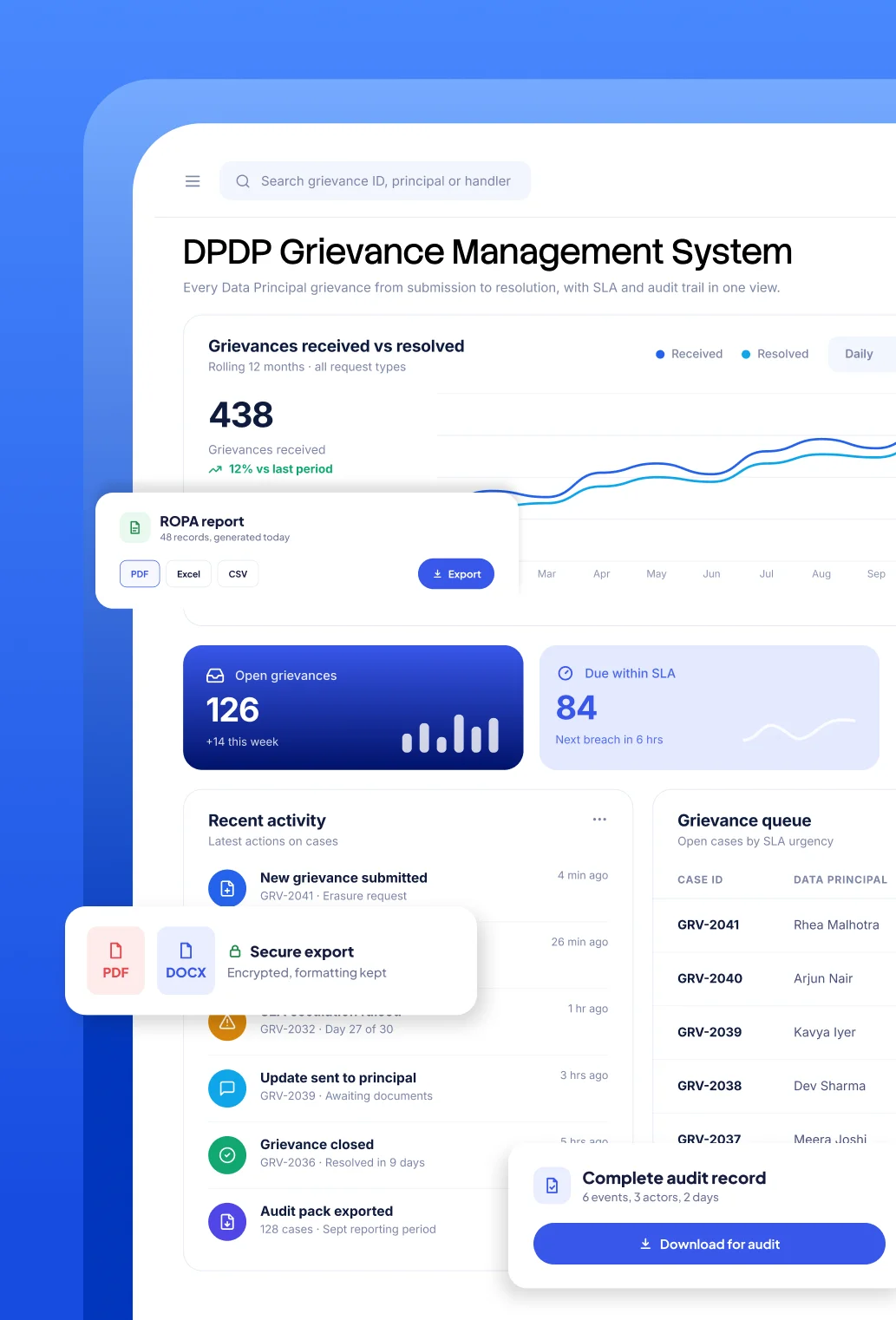
Locate patient information
Records are split between HMIS, EMR, lab, imaging, billing and pharmacy tools. DPDP.ai identifies and categorises this data, then maps it to its system, owner, purpose and retention period.
Medical histories, test reports and prescriptions are the most private information any organisation can hold. The DPDP Act expects hospitals, clinics, labs and health-tech platforms to guard it very carefully. DPDP.ai joins consent, patient requests and vendor tracking into one system, helping you keep patient trust and stay ready for audits.
Hospitals and digital health platforms act as Data Fiduciaries. The labs, billing firms, medicine delivery partners and cloud providers serving them are Data Processors. DPDP.ai lets you manage those roles from a single platform across every department and facility.
Records are split between HMIS, EMR, lab, imaging, billing and pharmacy tools. DPDP.ai identifies and categorises this data, then maps it to its system, owner, purpose and retention period.

Admission, outpatient visits, apps and teleconsultations each collect permission differently, often on paper. DPDP.ai offers multilingual, purpose-linked notices and one ledger for every consent and withdrawal that is synced across systems.

Data of a child usually requires a parent's or guardian's verifiable consent. DPDP.ai logs guardian consent and marks cases needing verification.

Consent Manager registration begins on 13 November 2026, and core duties apply from 13 May 2027. DPDP.ai's modules (Consent Core, Flow, Control, Govern) let you begin with consent and expand coverage step by step.

Fast data releases, outdated privacy notices, and weak deletion schedules keep data too long. With DPDP.ai you get regular reviews, automated deletion, and current vendor records.

A single violation can cost up to ₹250 crore, depending on which duty was missed. DPDP.ai reduces the risk through controls you can prove.
Clinical work values speed and easy access, which can clash with tight data control. These are the first gaps teams usually find.
Contact SalesPatient data is divided among HMIS, EMR, lab, imaging, billing and pharmacy software.
Admission and consent forms are still often on paper, making them hard to trace or prove.
Doctors, nurses, reception and admin staff all need records, and loose permissions increase misuse risk.
Insurers, TPAs, referral labs and telemedicine partners all receive patient details.
Staff need clear guidance on guardian consent for children and in case of emergencies.
Medical, legal and DPDP retention needs have to be balanced so nothing is held indefinitely.
Healthcare challenge: Patient data lies across HMIS, EMR, lab and billing systems
How DPDP.ai solves it: Scanning of all sources builds a live picture of where patient information is kept.
Healthcare challenge: Consent gathered on paper at several counters
How DPDP.ai solves it: Digital capture in local languages creates one provable record per patient.
Healthcare challenge: Staff can open more files than their role needs
How DPDP.ai solves it: The data map shows who holds which records so access can be narrowed by role.
Healthcare challenge: Reliance on labs, TPAs, insurers and telehealth partners
How DPDP.ai solves it: Every partner is reviewed on a schedule against the commitments in its data-processing contract.
Healthcare challenge: Guardian consent for children and dependants
How DPDP.ai solves it: Guardian permissions are stored and cases needing checks are highlighted.
Healthcare challenge: Patients asking to see, fix or delete their records
How DPDP.ai solves it: Requests are verified, sent to the right department and closed across connected systems.
Healthcare challenge: A leak of patient data
How DPDP.ai solves it: A guided workflow collects proof and moves the response from detection to timely notice.
Healthcare challenge: Trackers running on hospital sites and booking portals
How DPDP.ai solves it: Cookie controls give visitors a clear accept-or-refuse choice and remember it.









Clinical, compliance, and IT teams in healthcare ask us these questions most often.
Talk to an ExpertMost of the time, a hospital is a Data Fiduciary. It gets this status because hospital determines why and how patient data is used.
Yes doctors can provide treatment without consent in an emergency. The emergency needs to be a danger to life or health.
A parent or guardian is required to give verifiable consent for a child's data.
Hospitals can rely on one digital consent record for every patient, and replace scattered paper. They can do this with the help of DPDP.ai. It offers multilingual, purpose-linked notices and a single ledger for every consent and withdrawal which is synced across systems.
Learn how DPDP.ai can bring your patient systems, consent records and partners into one clear compliance view.
By submitting, you agree to our Privacy Policy. We'll only use your details to arrange the demo.