Up to ₹250 crore in penalties. Last few weeks to get DPDP compliant. 30weeksleft Start Today
TELECOM, MEDIA & INTERNET SERVICES

DPDP Act compliance
for Telecom

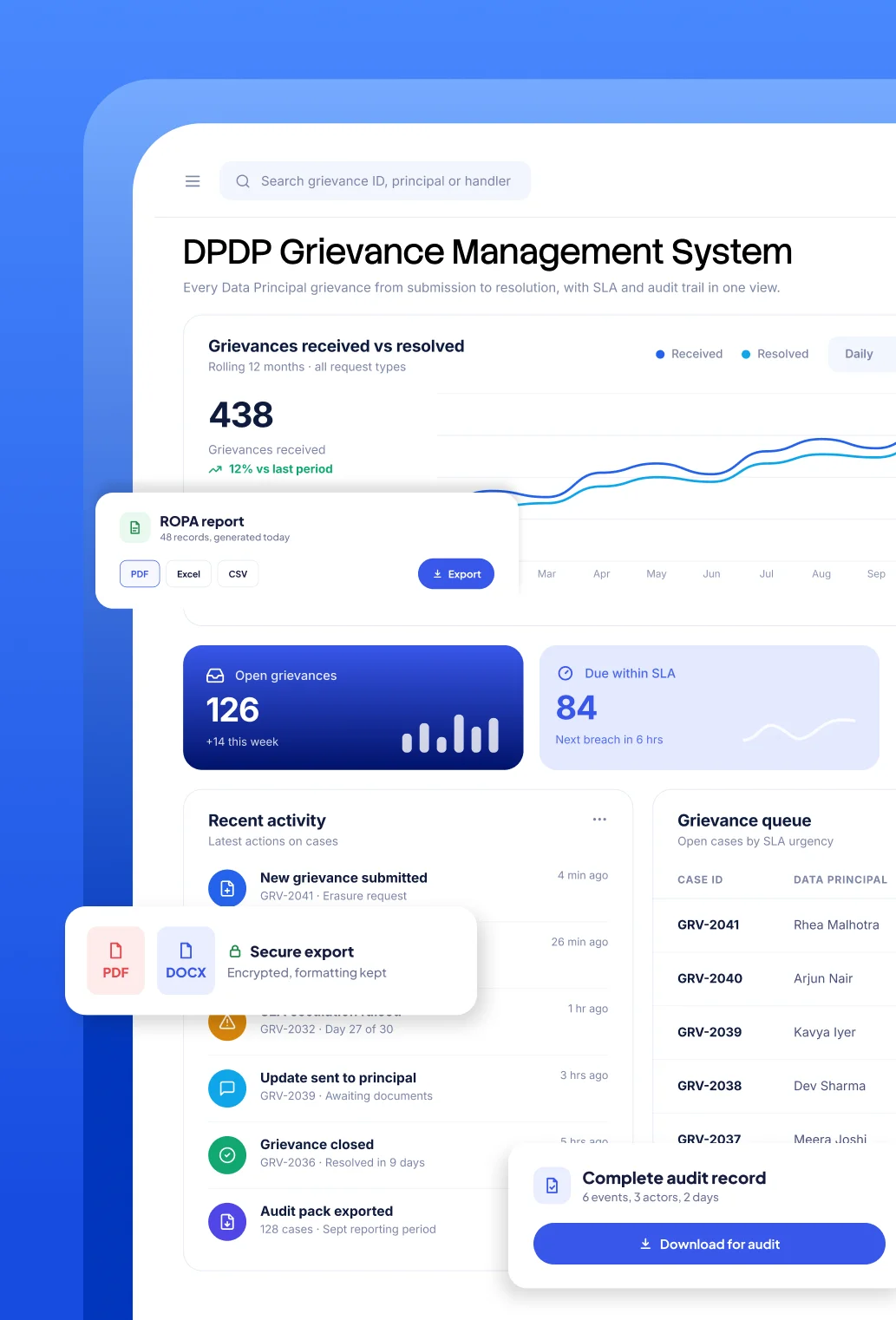
Subscriber identities, call details, cell-site location information and usage records move through telecom networks every second, and the DPDP Act that data as personal and you are responsible for them. DPDP.ai unites consent, subscriber requests and partner supervision in one system, keeping every circle and channel audit-ready.

  • RBI and DPDP mapped together
  • Notices in 22 languages
  • Go live in as little as 2 weeks
Why it matters

How Telecom Service
Providers are Affected?

In the telecom industry, operators and service providers are Data Fiduciaries. The call centres, billing firms, dealers and cloud hosts working for them are Data Processors. DPDP.ai gives you a single platform to carry out those duties across all channels and partners.

Know what subscriber data you hold

KYC files, call records, location and service usage details are scattered in billing, CRM, network and analytics tools. DPDP.ai finds and classifies them, then maps each to its system, owner, purpose and retention period.

One consent status for subscribers

Retail stores, apps, IVR, USSD and call centres each collect consent their own way. DPDP.ai issues purpose-based notices in many languages and records every approval and withdrawal in one ledger that updates connected systems at once.

Important DPDP dates for telecom

Consent Manager registration opens on 13 November 2026, and telecom operators must meet the DPDP obligations from 13 May 2027. DPDP.ai's modules let you start with consent for each subscriber and grow from there.

Two sets of rules, one compliance workflow

Licence conditions and telecom laws still apply alongside the DPDP Act. Data flow monitoring shows which personal data leaves your environment and who gets it, so each flow can be checked against both.

Retail and partner networks mapped

Telecom operators share customer data with dealers, retail agents and call centres, needing checks for everyone. dpdp.ai brings all those checks into one place.

DPDP penalties mean for telecom:

A violation can cost up to ₹250 crore, based on the duty missed, and operators are likely candidates for Significant Data Fiduciary status. DPDP.ai cuts that risk with controls you can evidence.


Challenges

Why compliance gets hard for telecom service providers

Old systems, millions of subscribers and wide dealer networks make DPDP compliance tough for telecoms. These gaps appear first.

Contact Sales
  1. 01

    Data across old and new systems

    Subscriber details are held in billing, CRM, network, KYC and analytics platforms built in different eras.

  2. 02

    Consent gathered inconsistently

    Telecom operators collect customer data through stores, apps, IVR and call centres, each following its own process, bringing gaps in DPDP compliance.

  3. 03

    Managing thousands of outlets

    Telecom operators rely on a vast network of third-party retailers to collect identity documents. So, each retailer handles sensitive customer data bringing safety issues and inconsistencies.

  4. 04

    Location tracking and usage across systems

    Network and device data shows subscribers’ movement and behaviour, so telecoms must set a clear purpose and a firm retention limit for that information.

  5. 05

    Consent for offers and data sharing

    Telecom operators send promotions, sell services and share data with partners. Each of these needs the subscriber's clear consent, and the data should only be used for the purpose they agreed to.

  6. 06

    Millions of subscribers bring big risks

    Telecom operators serve millions of subscribers, so access, correction and erasure requests arrive in large numbers. A single breach can also affect a huge number of people at once.

How DPDP.ai helps

Get Solutions for every
telecom challenge with DPDP.ai

  • Telecom challenge: Subscriber data spread over billing, CRM, KYC and network platforms

    How DPDP.ai solves it: Scanning of structured and unstructured sources creates a continuously updated data map.

  • Telecom challenge: Different consent practices in stores, apps and call centres

    How DPDP.ai solves it: A single consent engine governs capture, version history and withdrawal on every channel.

  • Telecom challenge: Dealers, agents and outlets handling identity documents

    How DPDP.ai solves it: Each one is reviewed on a schedule against the terms of its processing agreement.

  • Telecom challenge: Location and usage data kept without firm limits

    How DPDP.ai solves it: Classification and retention rules confine use to the stated purposes.

  • Telecom challenge: Promotional and partner sharing without clear permission

    How DPDP.ai solves it: Purpose-based consent keeps marketing and partner use apart from core service.

  • Telecom challenge: A huge volume of subscriber requests

    How DPDP.ai solves it: Requests are logged, routed and closed across connected systems within deadlines.

  • Telecom challenge: A breach spanning network and support systems

    How DPDP.ai solves it: A guided workflow collects proof and steers the response from detection to timely notice.

  • Telecom challenge: Likely Significant Data Fiduciary duties, such as DPIAs and a DPO

    How DPDP.ai solves it: Assessments run on a set schedule, and the supporting evidence is kept ready for review.

Trusted by banks, insurers and lenders across India

FAQs

Your Questions on DPDP for telecom, answered.

Compliance, network and IT teams at telecom companies ask us these questions the most.

Talk to an Expert
Is a telecom operator a Data Fiduciary?

Yes, it is. The telecom operator decides how subscriber data is gathered and processes, making it a Data Fiduciary.

Is subscriber call and location data personal data?

Yes, subscriber identities, call details, cell-site location and usage records are all personal data under the DPDP Act.

Who are Data Processors in the telecom industry?

Call centres, billing firms, dealers and cloud hosts working for a telecom operator are Data Processors.

What are the key DPDP deadlines for telecoms?

Consent Manager registration opens on 13 November 2026, and telecom operators must meet the main DPDP duties from 13 May 2027.

How can DPDP.ai help a telecom operator stay compliant?

DPDP.ai brings consent, subscriber requests and partner checks into one singular system. It maps subscriber data covering billing, CRM and network tools. It also manages one consent record across stores, apps and call centres. It also keeps evidence ready for review.

Get started

Organise subscriber data now,
before the audit begins

Learn how DPDP.ai can pull subscriber records, consent and partners into one clear compliance view.

  • Live demo on a banking use case
  • Gap assessment across consent, data and vendors
  • Go live in as little as 2 weeks

    By submitting, you agree to our Privacy Policy. We'll only use your details to arrange the demo.