Businesses don’t have to appoint a Consent Manager, but customers may use one, so you must honour external consent and withdrawal instructions. Companies wanting to register need Indian incorporation, ₹2 crore net worth, and 17 documents; there is no fee. Registered Consent Managers must keep records for 7 years and not view the data they route.
India’s DPDP framework is moving closer to full implementation. It brings important changes to how businesses manage consent. Rule 4 of the DPDP Rules, 2025, together with the Consent Manager registration framework under the DPDP Act, 2023, took effect on 13 November 2026. That’s the second phase done, with only the final phase left. The very next day, MeitY opened the registration portal at dpbi.gov.in.
Companies in India that satisfy the eligibility criteria can now apply to be registered as Consent Managers.
What does the Consent Manager Framework change for a Business?
The Consent Manager framework came into force on 13 November 2026.
Registrations opened the next day (14 November) and the Data Protection Board of India will approve the registrations.
There is no change to the enforcement date. The fiduciary obligations, rights of Data Principals and the processes for imposing penalties by the Board come into effect on 13 May 2027. So this news creates no new compliance deadline for most businesses, however the consents you will have to manage will change.
What is a Consent Manager Framework?
This is the process for obtaining and managing consent within an organisation. This includes rules, processes, tools and responsible parties. It ensures you obtain, store and manage consent correctly. A good framework will show that you are compliant with the DPDP Act throughout the process. It will help answer the following questions:
- How do we ask for consent?
- How do we store it and keep it safe?
- How do we make sure data is used only for the agreed purpose?
- What happens when someone changes or withdraws consent?
- How do we prove we followed the rules in an audit or investigation?
How does the Framework Affect a Data Fiduciary?
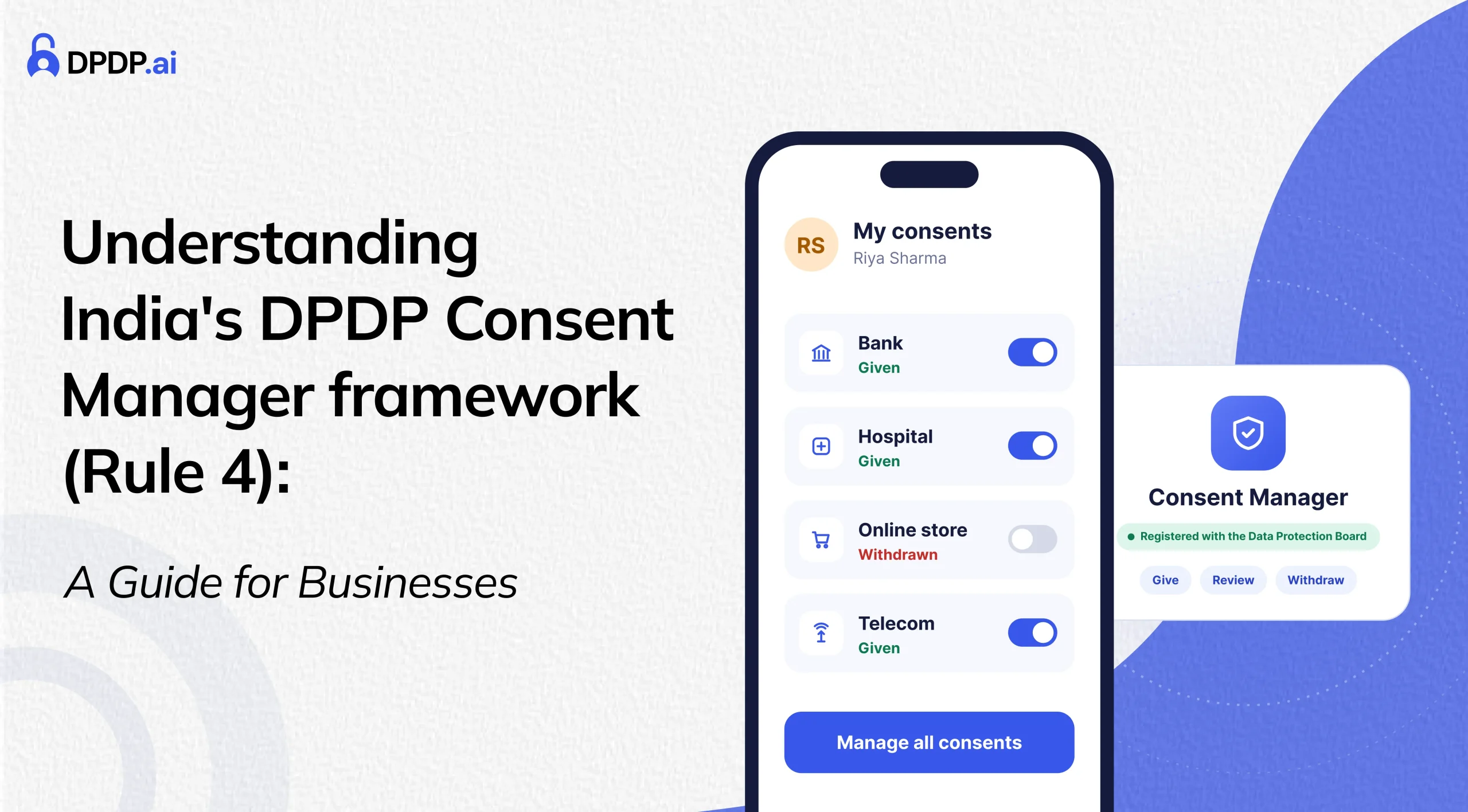
You don’t have to appoint a Consent Manager. Whether to use a Consent Manager is the Data Principal’s choice. You can continue to request consent in the normal way, as long as you comply with the notice, consent, withdrawal and storage requirements set out by the Act.
However, your customers may use a Consent Manager. You will have to comply with any consent/withdrawal instructions from outside your application. Once consent is withdrawn, you must stop processing the data and ensure your processors do also within a reasonable timeframe.
To check whether a vendor is genuine, look at the Board’s website. It must publish details of every registered Consent Manager.
What are the registration requirements for a Data Fiduciary to become a Consent Manager?
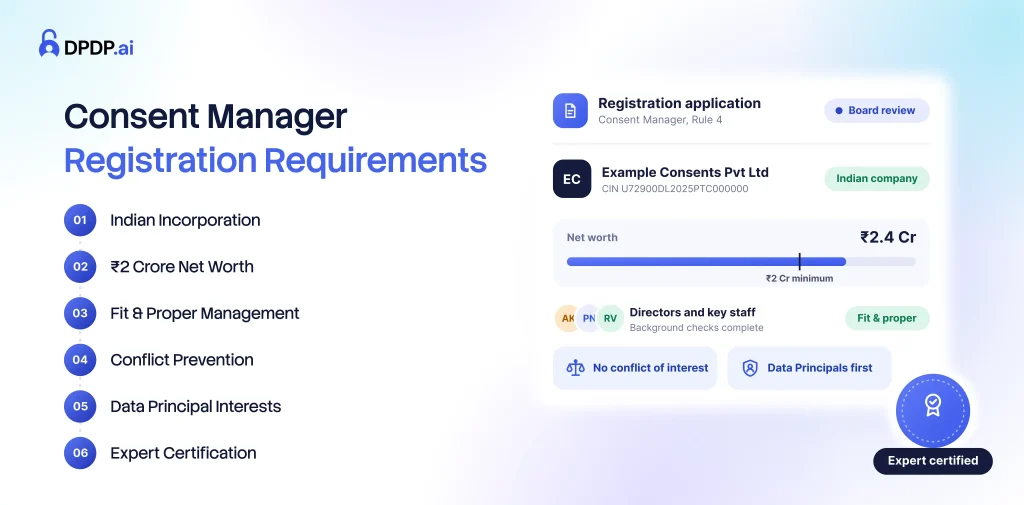
If you plan on registering as a Consent Manager, you must meet some requirements. The DPDP Rules lay these conditions down in the First Schedule.
Below is the simple breakdown of the requirements:
- The company must be registered in India. It should have the technical skills, the working systems, and the money to run the service properly.
- Its net worth should be at least ₹2 crore. It should be financially strong and have a realistic plan to run a business.
- The people running it must have a record of being fair and honest. This includes directors, key managers, and senior management.
- The company’s Memorandum and Articles of Association must contain provisions that prevent conflicts of interest.
- The company must always act in the best interests of Data Principals (the people whose data it handles).
- An independent expert must certify that the platform follows the standards published by the Board.
How to Register as a Consent Manager in India?
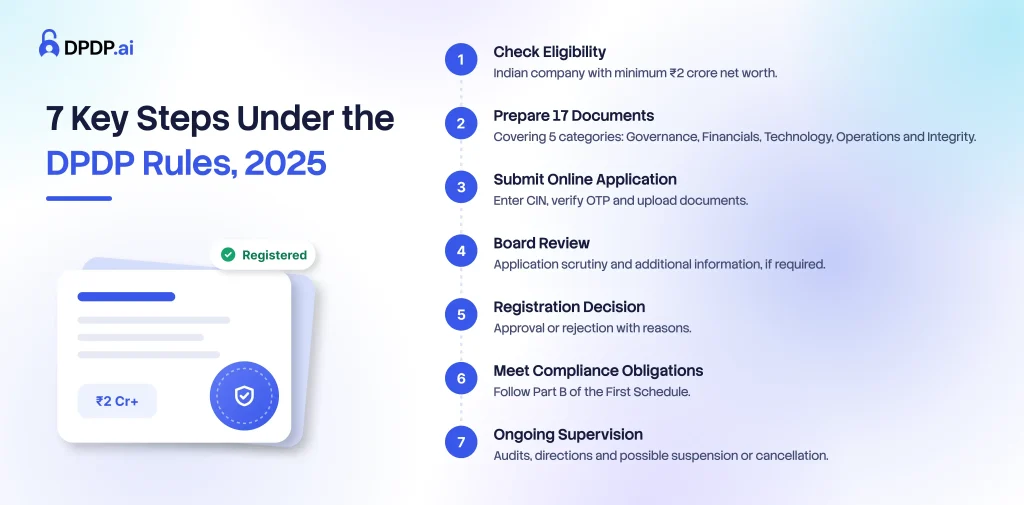
The process under Rule 4 of the DPDP Rules, 2025, has these steps:
Check eligibility
- Confirm you meet the registration conditions under the DPDP Act and Rules.
Documents Preparation
- Prepare complete documentation as per the portal’s readiness checklist. It lists 17 documents in five groups; they are:
Company Governance
- Certificate of Incorporation
- Memorandum of Association
- Articles of Association
Financials
- Audited financial statements for the last three financial years.
- Annual turnover certificates from a practising Chartered Accountant
- A certificate from a practising Chartered Accountant confirming a net worth of at least ₹2 crore.
Technology
- System architecture overview that covers interoperability, security safeguards, hosting, the consent lifecycle, data-blind design, record-keeping and availability.
Operational Capacity
- Statement of operational capacity
- Description of key managerial personnel and senior management
- Governance structure and constitution of the applicant’s board
- Conflict-of-interest policy
- Internal audit and compliance monitoring plan
- Business continuity plan
- Business and capability plan
- Capital structure (showing promoters and shareholders above 2%)
Fairness and Integrity
- “Fit and proper” declaration for directors, key managerial personnel and senior management
- Declaration that operations will be conducted in the interests of Data Principals
Apply for registration
Fill in the online application form, upload the documents, and submit. On the portal, the process works as follows:
Before you can proceed, click tick boxes confirming that:
- The applicant must be a company incorporated in India.
- The applicant’s net worth is at least ₹2 crore.
- The MoA and AoA require that items 9 and 10 of Part B of the First Schedule are followed, that policies and procedures exist to ensure this, and that these provisions can be changed only with the Data Protection Board’s prior approval.
Log in, enter your CIN, and verify with an OTP sent to your MCA-registered company email.
There is no application fee or registration fee.
Board review
The Board examines the application and can ask for more information.
Decision
If the Board is not satisfied, it rejects the application and gives its reasons. If it is satisfied, it registers the applicant and makes public the names of approved Consent Managers.
Duties of the Consent Manager
A registered Consent Manager must follow the Part B obligations of the First Schedule.
Supervision
The Board can audit operations, issue directions, and suspend or cancel registration, but only after giving you a chance to be heard.
What are the Obligations of a Consent Manager after Registration?
Consent Manager duties after registration:
- You must retain records of consent, notice and data sharing for at least 7 years.
- Do not view any personal data you are routing.
- Do not outsource any of your obligations.
- Any changes to control must be approved by the Board. You must publish your promoters, management and holders (more than 2% of shares).
Failure to comply can result in fines of up to ₹50 crore, plus suspension or cancellation of registration.
What should Data Fiduciaries do now?
As Consent Manager registration is now open, the DPDP rules relating to Consent Managers have come into practice. As a Data Fiduciary you should:
- List every place where you collect consent. Also note which other companies or your Data Processors handle this data for you.
- Test your withdrawal process.
- Create a secure process to allow consent to be passed into your systems.
- If a vendor claims to be a Consent Manager, ask them to prove they are registered.
- If you would like to become a Consent Manager, start gathering your 17 documents.
You have 6 months until the main obligations come into effect. This should give you plenty of time to complete everything correctly, however you shouldn’t delay.
Conclusion
Consent Manager registration is now open. This shows that the DPDP rules are coming into practice. You don’t have to use a Consent Manager, but your customers might. Ensure your systems can handle any consent and withdrawal requests from outside your application.
The main obligations will begin to apply from 13 May 2027. Map out where you obtain consent. Test a full withdrawal. Check any vendors are registered on the Board website. If you want to become a Consent Manager, go to dpbi.gov.in and follow the registration process.