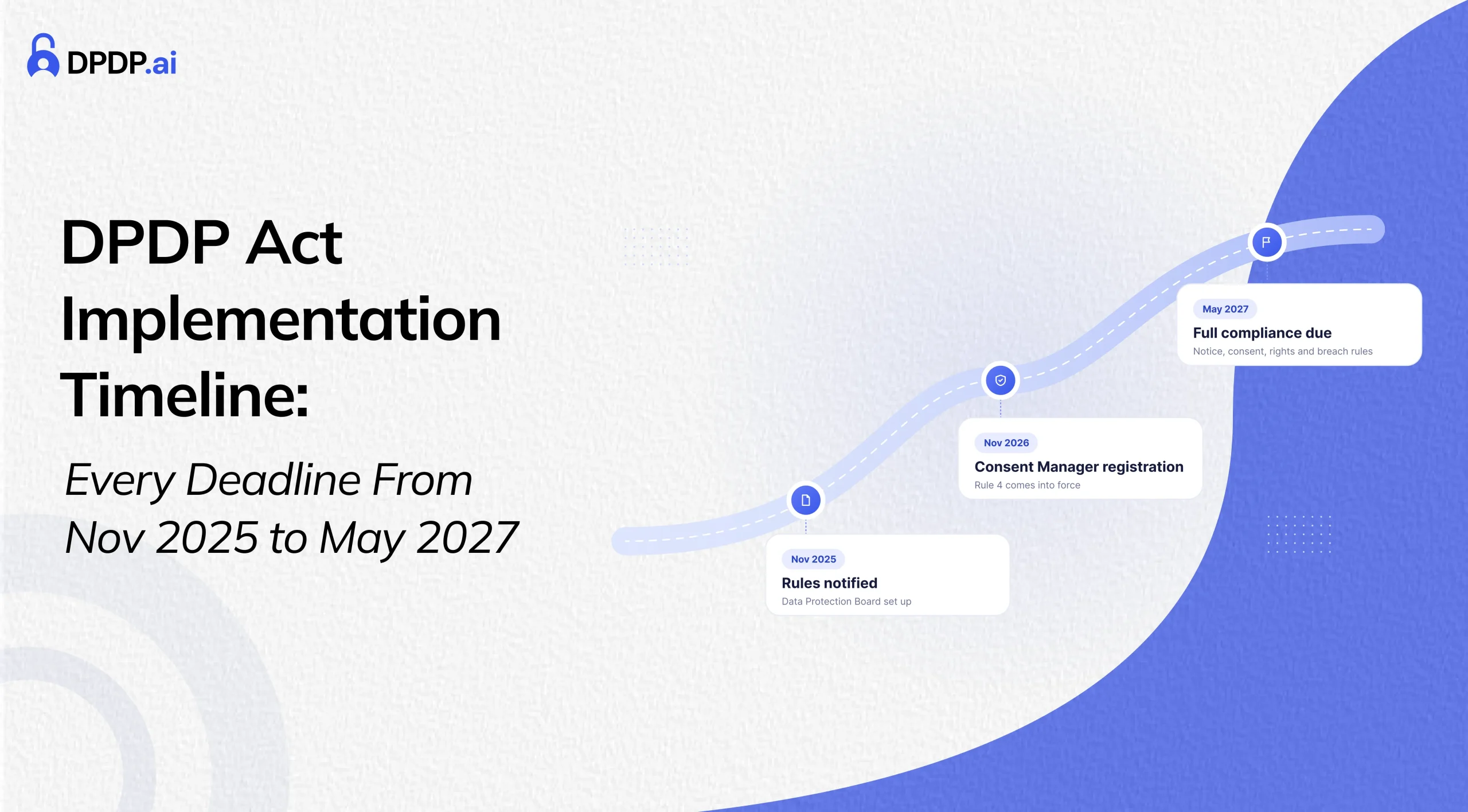
DPDP Act and Rules are being implemented in three phases. The institutional framework is already in place, and Consent Manager registration has commenced; most business compliance will take effect on 13 May 2027. Data fiduciaries or businesses should use the remaining time period to review their data practices, contracts, security controls, and grievance mechanisms. In simple words, they must prepare themselves for DPDP Compliance before the end of the deadline.
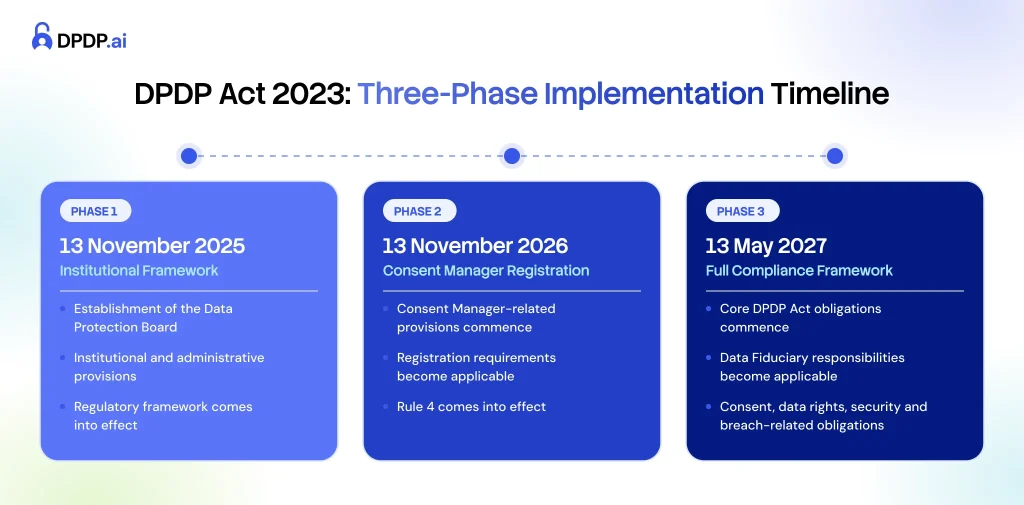
Three-Phase Implementation Date
The DPDP Act is not going to be enforced in a single day; it has been divided into 3 phases which will occur simultaneously. Here are the commencement dates:
| Date | Provision Commencing | Applicability |
| 13 November 2025 | Sections 1, 2, 18–26, 35, 38–43, Section 44(1) and 44(3), along with Rules 1, 2 and 17–21 | Institutional and administrative framework |
| 13 November 2026 | Section 6 (9), Section 27(1)(d) and Rule 4 | Consent Manager registration |
| 13 May 2027 | Remaining substantive provisions and Rules 3,5 – 16, 22 and 23 | Data Fiduciaries and other relevant entities |
What has Already Commenced?
13 November 2025: Data Protection Board Framework
The Data Protection Board of India (DPB) was established, alongside the commencement of institutional and administrative provisions.
13 November 2026: Consent Manager Registration
The Consent Manager registration framework is now effective under Section 6(9), Section 27 (1), and Rule 4.
A Consent Manager is a Board-registered entity that allows individuals to give, manage, review, and withdraw consent through a central interoperable platform.
Eligible Indian businesses can apply for the consent manager registration through the DPBI portal. Remember to check the full criteria, and the business should have a net worth of ₹2 Crore.
Businesses applying for registration must have their interoperable platform independently certified. From 13 May, 2027, registered Managers must use an operational platform that allows data principals to manage consent given to multiple data fiduciaries.
Currently, it is not mandatory for all businesses. However, organisations must check whether integrating with a registered Consent Manager fits their consent management processes.
The Proposed 12 Month Implementation Period
In January 2026, media reports suggested that MeitY was considering reducing the implementation period from 18 months to 12 months. This could have advanced the substantive compliance deadline to November 2026.
Businesses must plan against this date instead of waiting for the media reports about proposed amendments.
From 13 May 2027, the Board can investigate businesses, take appropriate action, and also impose penalities. That’s why businesses must get ready before the time as no grace period will be given.
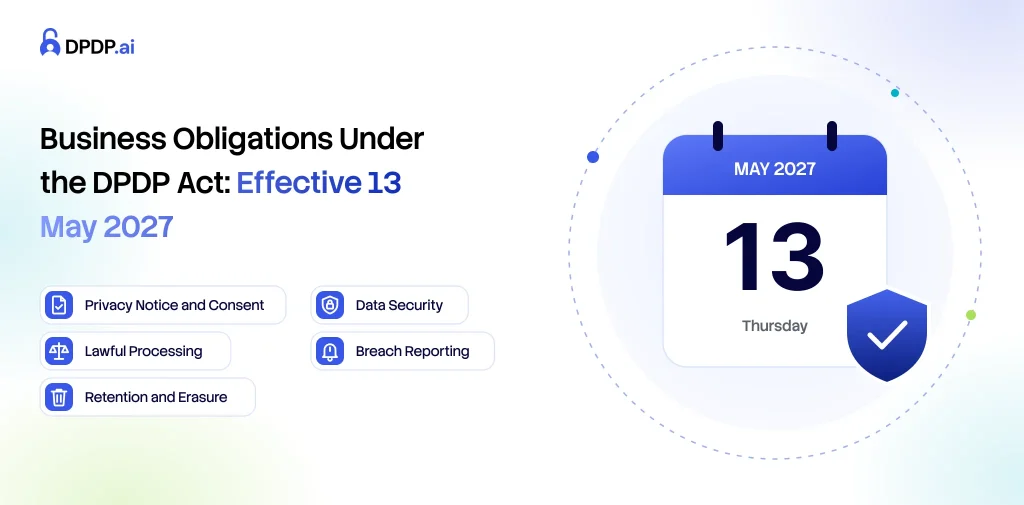
Business Obligations Effective 13 May 2027
13 May, 2027, the substantive provisions will require Data Fiduciaries to implement operational data protection controls.
The principal obligations include:
- Privacy Notice and Consent: Businesses should provide clear notices along with an explanation of how personal data is being processed and its purpose.
- Lawful Processing: Identify the applicable lawful basis for each processing activity; Section 7 permits specified legitimate uses without consent.
- Data Security: Implement reasonable technical and organisational safeguards to prevent personal data breaches.
- Breach Reporting: Notify affected individuals and the Board within the timelines prescribed under Rule 7.
- Retention and Erasure: Establish retention schedules and erase personal data when the applicable purpose and legal requirements no longer justify retention.
- Data Principal Rights: Make a mechanism for access, correction, erasure, and other applicable rights under the Act.
- Grievance Redressal: Implement an accessible mechanism for receiving and resolving complaints.
- Children’s Data: Comply with applicable requirements for verifiable parental consent and restrictions on processing children’s personal data.
- SDF Requirements: Organisations classified as significant Data Fiduciaries must meet additional obligations that include impact assessment and audits.
The Act is relevant to B2B organisations as well as consumer-facing businesses. Employee records, vendor contacts, customer representatives and other identifiable business contracts can constitute personal data.
Business Compliance Roadmap: November 2026 May 2027
Organisations should approach DPDP compliance as an operational project involving legal, IT, HR, procurement, information security and business teams.
| Period | Priority Actions |
| November-December 2026 | Map personal data, identify processing purposes and lawful grounds, check vendors and processors, evaluate potential SDF classification. |
| January-February 2027 | Update privacy notices, implement consent mechanisms, review processor contracts, set up security controls. |
| March 2027 | Implement rights request and grievance workflows, set up breach escalation procedures, conduct incident response exercises and employee training. |
| April – 13 May 2027 | Test controls, verify vendor compliance, validate retention configurations and document evidence. |
What is the penalty a business may face on violation?
| Violation | Maximum Penality |
| Not implementing reasonable security safeguards | ₹250 crore |
| Not reporting the affected Data Principal and the Board about the breach | ₹200 crore |
| Violation of additional obligations relating to children’s data | ₹200 crore |
| Violation of obligations applicable to Significant Data Fiduciaries | ₹150 crore |
| Any violation of the rules | ₹50 crore |
| Violation of duties by the Data Principal | ₹10,000 |
Conclusion
13 May 2027 is the main deadline before businesses must prepare for the DPDP Act. Being compliant with DPDP does not mean only setting a privacy policy. Businesses must ensure that DPDP rules are being followed in data collection, processing, security, retention, sharing, and deletion.
Businesses should begin with data mapping, vendor assessments, and lawful basis identification, followed by implementation and testing of operational controls. This will prepare them for the timeline and avoid heavy penalties.