Businesses often share personal data with third-party vendors, including cloud providers, SaaS companies, payroll services, CRM platforms, and payment providers. Means data leaks can occur from multiple points. However, it does not mean that a business can say leaks happen because of the vendor. Because the DPDP Act says that even if a personal data breach occurs from the vendor, the business will still be responsible. It makes it essential for businesses to manage vendor risk carefully. To understand vendor risk management under the DPDP Act in detail, read the full blog.
What is Vendor Risk Management Under the DPDP Act?
Vendor risk management is the process of identifying, checking, controlling, and monitoring risk.
Generally, vendor ecosystems include:
- Cloud and Hosting providers
- Payroll and HR Platform
- CRM Provider
- Customer support vendors
- Marketing platforms
- IT Service providers
- Analytics Providers
What are Key Vendor Management Risks?
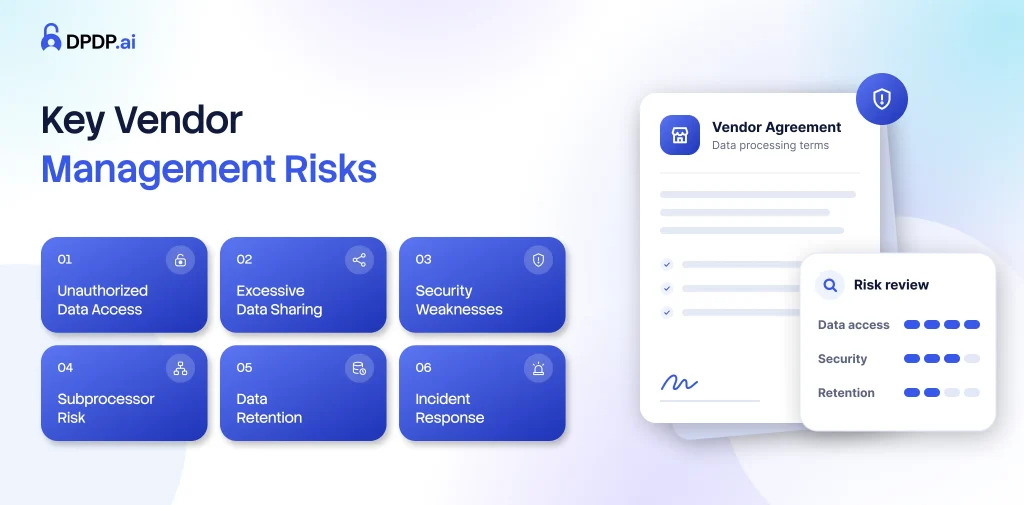
These are the risks a vendor must check:
- Unauthorized Data Access: A vendor may expose personal data to employees, contractors, or systems that do not require access.
- Excessive Data Sharing: Sharing more personal data of data principal can increase the risk of a security and privacy incident.
- Security Weakness: Weak authentication, inadequate access controls, poor vulnerability management, and insufficient monitoring can increase exposure.
- Subprocessor Risk: A vendor may rely on additional service providers, creating another layer of third party risk that needs to be checked.
- Data Retention: Personal data may remain with a vendor longer than necessary if retention and deletion requirements are not cleary established.
- Incident Response: Delayed notification or poor coordination during a personal data breach can make incident management more difficult.
Who is responsible when a vendor handles personal data?
Under Section 8 (1) of the DPDP Act, the data fiduciary is responsible for compliance even if the compliance issue occurs with the Data Processor or vendor. This means a contract saying “the vendor is responsible for privacy compliance” does not by itself, transfer the organization’s statutory responsibility.
What are the essential DPDP Act provisions for vendors?
| Provision | What it Covers | What it means for Vendors |
| Section 2(k) | Define Data Processor | Work out which vendors process data |
| Section 6 (6) | Consent Withdrawal | Both data fiduciary and processor should stop processing |
| Section 8 (1) | Fiduciary Accountability | Vendor failures create compliance exposure for you |
| Section 8 (2) | Valid Contract | Every covered processor needs a contract |
| Section 8 (5) | Reasonable Security Safeguards | Safeguards must cover processing by vendors |
| Section 8(6) | Breach notification | Vendor incidents must reach you in time for you to notify |
| Section 8(7) | Erasure | Cause your processors to erase data supplied to them |
| Section 11 | Right to information | Data Princial has the right to ask which processors received their data |
| Section 16 | Cross Border Transfers | The Government may restrict transfer to notified countries |
| Rule 6 | Minimum Security Safeguards | Reflect these in processor contracts and assessments |
| Rule 7 | Breach Notification Process | Sets the notification content and timelines |
| Rule 8 | Retention and logs | Coordinate retention and deletion with processors |
| Rule 13 | DPIA and auditor for Significant Data Fiduciaries | Include vendor processing in risk assessments |
| Rule 15 | Cross-Border Transfer | Track overseas processing and any specified requirements |
What Should a DPDP Vendor Contract Include?
A vendor contract should contain privacy and security expectations as clear contractual obligations:
Scope of Purpose and Processing
A data fiduciary should define the services being provided and how the vendor is permitted to process personal data.
Data Security
Depending on the risk, contractual requirements may address:
- Access controls
- Authentication
- Encryption
- Security Monitoring
- Vulnerability management
- Incident Response
Confidentiality
Personnel who have access to personal data should be subject to appropriate confidentiality obligations.
Personal Data Breach Management
The agreement should clearly mention how incidents are reported and escalated, including:
- Notifications procedures
- Required incident information
- Investigation support
- Containment and remediation
- Evidence and audit trails
Subprocessors
Organizations should also define how subprocessors are identified, approved, monitored, and managed when they have access to personal information.
Retention and Deletion
Contracts should establish expectations for retaining, returning, or deleting personal data when the processing purpose or contractual relationship ends.
Audit and Assurance
For higher-risk vendors, organisations may require appropriate assurance evidence, such as security assessment reports, certifications, questionnaires, or audit rights.
Risk-Based Vendor Classification
Not every vendor requires the same level of scrutiny:
Low Risk
Vendors with no personal data access or very limited exposure may require:
- Basic due diligence
- Standard contractual requirements
- Periodic review
Medium Risk
Vendors processing limited personal data and supporting important business functions may require:
- Detailed Due Diligence
- Privacy and security assessment
- Specific contractual control
- Periodic reassessment
High Risk
Vendors handling large volume of personal data supporting essential systems, or having access, may need:
- Enhanced due diligence
- Detailed security assessment
- Strong contractual safeguards
- Assurance evidence
- More frequent monitoring
- Formal remediation tracking
Ongoing Vendor Monitoring
Vendor risk should be reviewed throughout the relationship instead of during onboarding only. Monitoring may include:
Periodic privacy and security assessments
- Changes in processing activities
- New Subprocessors
- Security Incidents
- Material changes to the vendor’s environment
- Contract renewals
- Data Retention practices
- Business continuity considerations
What happens if a Vendor Experiences a Personal Data Breach?
If a data breach occurs, the vendor must inform the data fiduciary as soon as possible. It should assess the breach, conduct an impact assessment, and work with the vendor to investigate and remediate the incident.
Under the DPDP Rules, 2025, the Data Fiduciary must notify the affected Data Principal and the Data Protection Board within 72 hours. After the breach, the organisation should review the vendor’s security measures and take steps to prevent the same issue from happening again.
What are the common vendor risk management mistakes?
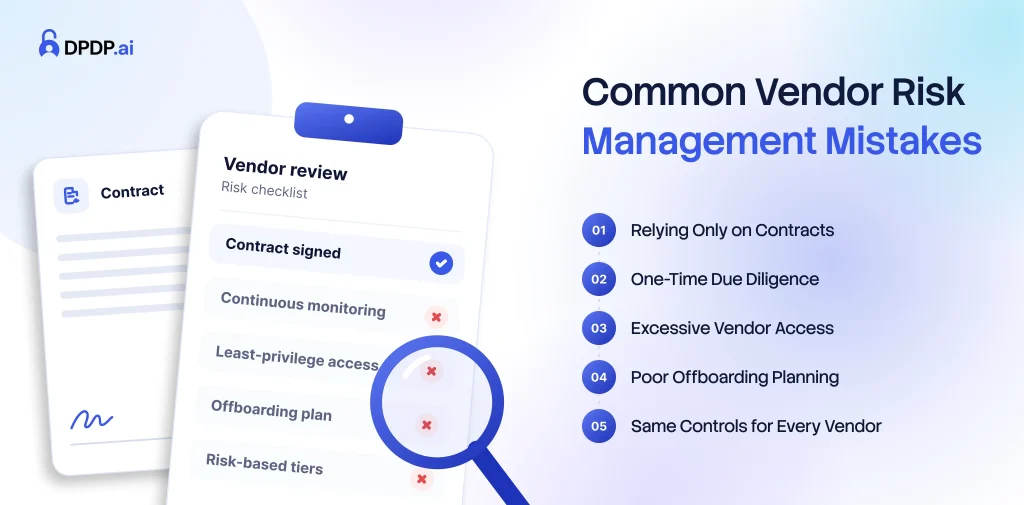
A Data Fiduciary should avoid the following mistake to reduce compliance issue:
- Treating the Contract as the Entire Compliance Programme
Contractual protections are important, but they need to be supported by operational and security controls.
- Conducting Due Diligence Only Once
Vendor risk can change because of new subprocessors, services, systems, incidents, or ownership changes.
- Giving Vendors Excessive Access
Vendor access should be limited to the data and systems required for the agreed service.
- Failing to Plan for Offboarding
Vendor exit procedures should cover the data return and deletion, access revocation, credentials, integrations, and other relevant closure activities.
- Applying the Same Controls to Every Vendor
A risk-based approach allows organizations to apply stronger controls to vendors that create greater privacy or security exposure.
Conclusion
Third-party vendors can create privacy and security risks if they are not properly managed. Businesses should follow a risk-based process that covers due diligence, access controls, monitoring, breach response, and offboarding. Vendor risk management helps data fiduciaries protect personal data while supporting practical and effective DPDP compliance. Following the laws and compiling DPDP compliance is necessary.
FAQs
Ques: What is Vendor risk management?
Ans: Vendor risk management refers to the structured process of identifying, assessing, monitoring, and managing third-party risk. It covers cybersecurity, privacy, regulatory, operational, financial, and compliance risk.
Ques: What are the 5 stages of risk management?
Ans: Generally, the 5 stages of risk management are:
Risk identification, risk assessment, risk treatment, risk monitoring, and risk reporting/review.
Ques: What happens to personal data held by a vendor when a Data Principal withdraws consent?
Ans: If the consent is withdrawn, it is a duty of the data fiduciary to ensure the data principal’s information is deleted from both the fiduciary and processor systems.
Ques: How soon must a personal data breach involving a vendor be reported under the DPDP Act?
Ans: It should be reported within 72 hours of the breach and 6 hours to cert in.
Ques: Does the DPDP Act require organizations to enter into a Data Processing Agreement (DPA) with vendors?
Ans: DPDP Act Section 8(2) requires a Data Fiduciary to engage with a Data Processor for relevant processing only under a valid contract.
Ques: Who is responsible for a personal data breach caused by a Data Processor?
Ans: Data Fiduciary is the responsible entity for compliance under Section 8 of the DPDP Act.