Do you need a Privacy Impact Assessment (PIA) under India’s Digital Personal Data Protection (DPDP Act? It is a growing concern for data fiduciaries in India, especially since the penalties depend on the breach: up to ₹250 crore for failing to take reasonable security safeguards, and up to ₹150 crore for breaching SDF obligations.
The DPDP Act does not use the term PIA, but Section 10(2)(c) requires Significant Data Fiduciaries to conduct periodic DPIAs. However, the accountability and obligations for SDFs (Significant Data Fiduciaries) make privacy impact assessments essential. In this guide, you will get to know when you need a PIA and how it differs from a DPIA.
What is a Privacy Impact Assessment?
A Privacy Impact Assessment (PIA) is a structured process for identifying privacy risks arising from the collection, use, storage, or sharing of personal data. Organizations use PIAs to improve risk management, demonstrate accountability, and improve individual trust.
Under the DPDP Act, a DPIA (Data Protection Impact Assessment) is used, which a Significant Data Fiduciary must conduct. PIA is a broader governance tool compared to the DPIA, a specific regulatory requirement assessment.
Is a Privacy Impact Assessment Mandatory Under the DPDP Act?
Not for every business. Under the DPDP framework, only Significant Data Fiduciaries (SDFs) must carry out a Data Protection Impact Assessment (DPIA).
Once a company is notified as an SDF, Rule 13 requires it to complete a DPIA and an audit once every 12 months, counted from the date of notification.
When do these Obligations Apply?
These SDF duties under Rule 13 begin on 13 May 2027. A Data Fiduciary becomes an SDF only when the Central Government notifies it, based on factors such as the volume and sensitivity of data processed and risk to Data Principal rights. Beyond the DPIA, an SDF must also appoint an India-based Data Protection Officer who reports to its Board, and an independent data auditor. Under Rule 13 of the DPDP Rules, an SDF must conduct a DPIA and an audit once every 12 months, counted from the date it is notified.
How to Conduct a Privacy Impact Assessment?
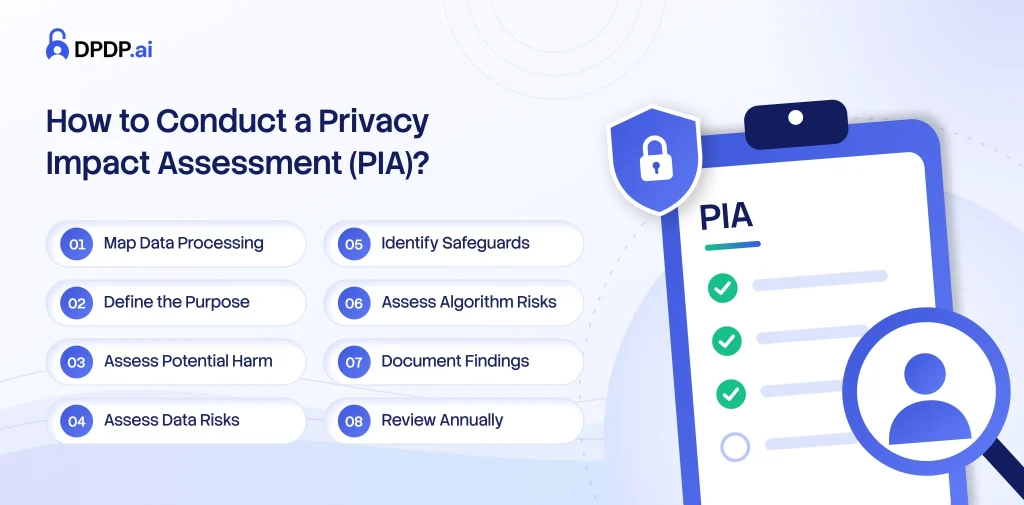
Here is the workflow for conducting a PIA best-practice workflow aligned to Rule 13:
- Map the processing activities: Identify what personal data is collected, how it is processed, where it is stored, and who accesses it.
- Define the Purpose: Clearly document why the personal data is being collected and processed.
- Assess Potential Harm: Identify and check possible risks or harm to Data Principals arising from the processing.
- Assess Data Risks: Weigh factors such as the volume and sensitivity of the personal data and how processing could affect individuals.
- Identify Safeguards: D
ocument the technical and organizational measures used to manage and reduce identified risks.
- Assess Algorithm Risks: Where relevant, review any algorithmic software used in processing to confirm it does not put Data Principals’ rights at risk.
- Document the findings: Record of processing activities, purposes, identified risks, risk reduction measures, and significant observations.
- Review Annually: Rule 13 of the DPDP Rules, 2025 requires the person carrying out the DPIA and audit to send the Data Protection Board a report of their significant observations. Others should reassess when products, vendors, or data types change.
DPDP DPIA Vs GDPR PIA
| Requirement | DPDP Act, India | GDPR, EU |
| Who Must Conduct | SDF (Significant Data Fiduciary) | Controllers undertaking high-risk processing |
| When it is mandatory | SDFs must conduct a DPIA | When processing is likely to create a high risk to individual rights and freedoms |
| Assessment Focus | Processing, purpose, potential harm, and risk management measures | Necessity, proportionality, and safeguards |
| Frequency | At least once every 12 months for SDFs |
Review again whenever risk changes, as the rules set no fixed annual cycle |
| Regulatory Involvement | Report observations to the Data Protection Board | Prior consultation may be required where high risks cannot be reduced |
| Key Provision | Section 10(2)(c) of DPDP Act, and Rule 13 of DPDP Rules, 2025 | Articles 35-36, GDPR |
What are the common mistakes to avoid?
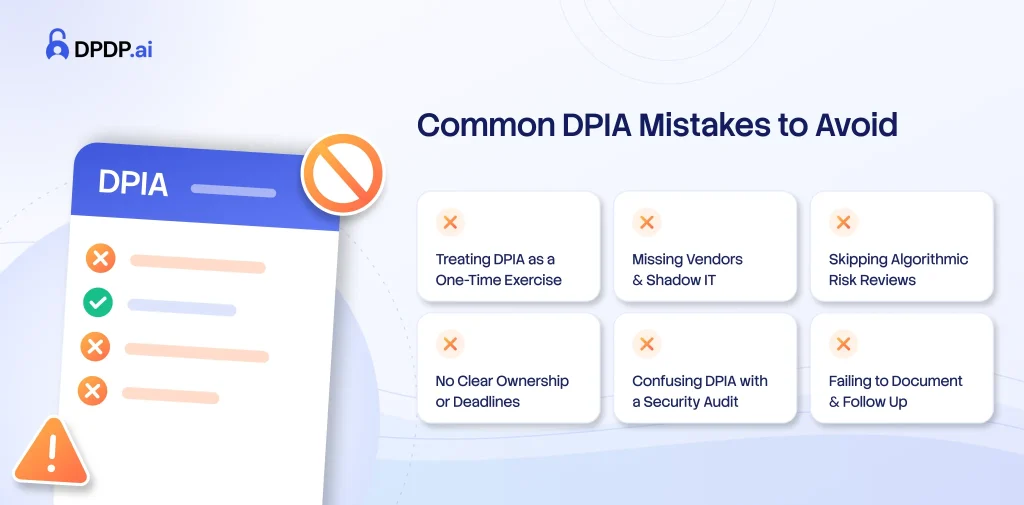
- Treating the DPIA as a one-time exercise rather than an ongoing process.
- Mapping only core systems and missing vendors, processors, and shadow IT.
- Skipping the algorithmic risk review
- Recording findings without an owner or a deadline
- Confusing a security audit with a D
PIA. A security audit checks controls, while a DPIA assesses risk to Data Principals’ rights.
Conclusion
PIA (privacy risk assessment) is a structure to identify the risks that can occur due to failure in data protection. The DPDP Act does not use the PIA; instead, it uses DPIA Data Protection Impact Assessment). According to DPDP, a Significant Data Fiduciary must conduct a DPIA annually and also submit a report to the Data Protection Board. Apart from SDF. An SDF can follow a structured DPIA workflow to streamline the process, or use DPIA tools to automate it.
FAQs
Ques: Why does the DPDP Act require a DPIA?
Ans: A Privacy Impact Assessment (PIA) is a systematic process for identifying privacy risks before or during the processing of personal data. It helps businesses protect personal data and avoid penalties.
Ques: Is it mandatory to conduct a PIA in India?
Ans: The DPDP Act makes a DPIA, not a PIA, the mandatory requirement for Significant Data Fiduciaries. A Data Protection Impact Assessment should be conducted by an SDF (Significant Data Fiduciary). However, a PIA can be conducted by Data Fiduciaries for data protection.
Ques: How does a DPIA differ from a PIA?
Ans: A PIA is a broader privacy risk approach. Whereas DPIA is a specific data protection assessment required under certain privacy laws. DPIA is used under the DPDP framework.
Ques: Does every Data Fiduciary have to carry out a DPIA?
Ans: No, only the SDFs are required to conduct a DPIA under the DPDP Act.
Ques: How frequently must an SDF carry out a DPIA?
Ans: Under Rule 13 of the DPDP Rules, 2025, an SDF is required to conduct a DPIA every 12 months.