Most of the businesses don’t know where they have stored their customer’s personal data. Personal data is scattered across databases, cloud apps, emails, and old files. Businesses need to track this personal data and if it is not done repeatedly, it brings the risks of data leaks.
Hackers use leaked data for fraud, phishing, and identity theft. A breach can’t be undone, and the customer pays for it.
PII discovery fixes this issue as personally identifiable information (PII) is scattered across your systems. With PII Discover tools, you can secure customers’ personal data before someone uses it. PII Discovery is also the foundational step for complying with India’s Digital Personal Data Protection (DPDP) Act.
In this guide, we explain what PII discovery is, how it works, and why it matters for your business.
What is PII Discovery?
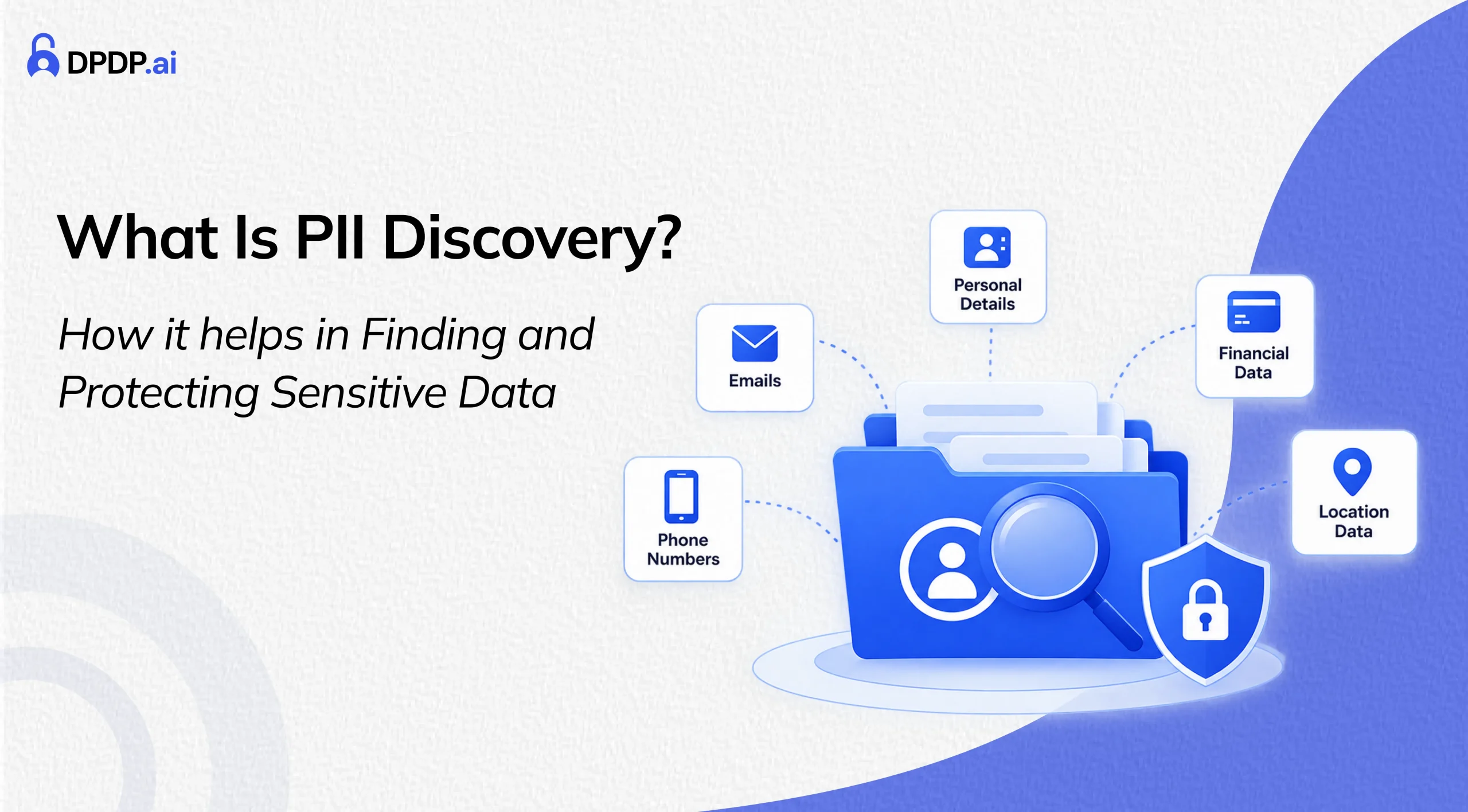
PII Discovery means Personally Identifiable Information Discovery. It is a process of finding personal data through the whole system of any business. With a PII Discovery tool, the data discovery becomes an automatic process of scanning a business’s whole digital system. After data’s discovery comes locating and categorizing any sensitive personal data.
In simpler words, PII is any data that can be used to identify, contact, or find a single person. It is basically like a digital footprint for an individual.
With the introduction of the DPDP Act, protecting personal data has become the primary objective for companies. So if your business wants to protect personal data, you need to locate where that personal data is, throughout your whole organisation.
PII can be classified into two categories:
Direct Identifiers: They are the labels (identifiers) that can precisely identify you. The examples for Direct Identifiers are: A person’s full name, government identification numbers, contact information, account and financial identifiers, and biometric information.
Indirect Identifiers: These are the labels (identifiers) that are less unique and do not identify you precisely. But when combined together, they can precisely identify you. The examples for Indirect Identifiers are: Date of birth, gender, IP address, device IDs, browser cookies, geolocation data, and behavioral data.
PII Data Discovery Helps In Finding Sensitive Data
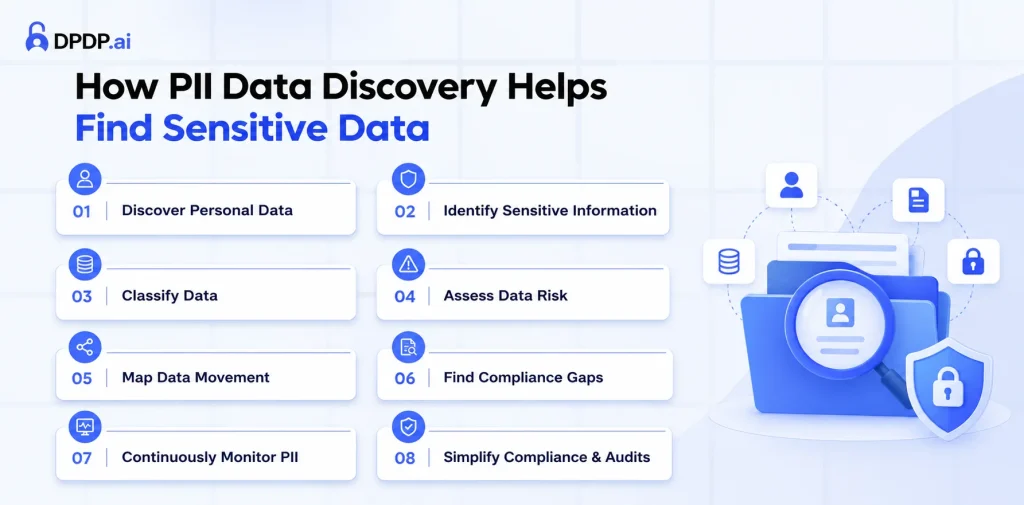
PII Discovery helps businesses to locate personal data across databases, cloud apps, files, APIs, and AI tools. A PII Data Discovery tool automatically scans all of the places where personal data sits and tells you what you have.
It turns hidden personal data into a clear organised list. This helps you to secure the data, reduce breach risks, and prove compliance.
This is how it helps:
- It scans through all your structured and unstructured databases, files, PDFs or any other source. This also includes the forgotten data that sits in your systems.
- This scan helps you in spotting details like names, phone numbers, email IDs, Aadhaar, PAN, and more. It then sorts personal data by type and risk.
- Classification helps in labelling each data by type and sensitivity.
- The sensitive data is then marked with high, medium, or low risk levels.
- It shows you how data moves throughout your whole system and third-parties.
- The actions above help in catching issues like missing consent records, unencrypted PII, weak access controls, and data kept longer than needed.
- As databases change daily, it runs continuous scans and adds or updates new PII as it appears.
- Regular scans throughout your whole system help you manage data efficiently and find gaps in data handling.
- These findings make audits easier and make you compliant with laws like DPDP Act and GDPR.
PII Data Discovery Helps In Protecting Sensitive Data
After knowing where personal data lives on your systems, you can then protect it. PII Data Discovery tool gives you visibility of your whole system. Then every other security step depends on.
This is how it protects:
- As data is located and classified, you now know which data is sensitive and where it sits.
- It labels the data into high, medium and low risk data to help you secure the most exposed and risky data first.
- It exposes weak spots like unencrypted PII and loose controls over data so you can fix them before they lead to a breach.
- The continuous scans help in finding old, duplicate, changed or forgotten data so you can manage those data easily.
- Data flow maps show where PII travels across systems and vendors so you can spot risky transfers.
- During a breach, you already know what data was affected, which makes reporting within deadlines much easier.
- Clear data handling gives clear records and audits that show regulators that you handle data responsibly.
Why Is PII Data Discovery Important Now?
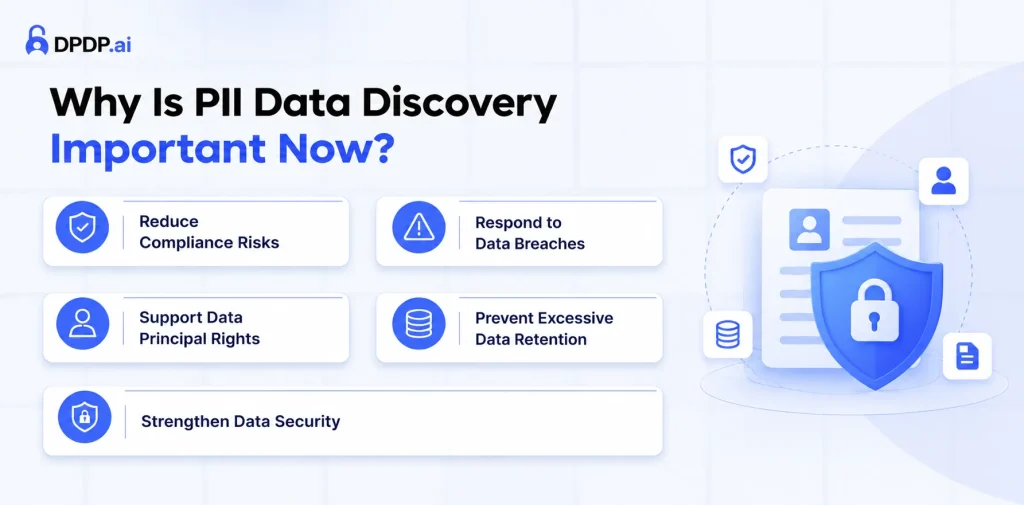
PII Data Discovery is the first step to manage massive datasets and to be compliant with privacy laws.
After the introduction of the DPDP Act, individual privacy has given more importance. The DPDP Act has real deadlines and non-compliance is not an option for businesses. The DPDP Act was formally notified in 2023 giving businesses up to 18 months to comply with the set guidelines under the Act.
The PII Data Discovery has become suddenly urgent because of these strict compliance requirements under the DPDP framework:
- In case of any violation, the organisation is liable to pay penalties of up to ₹250 crore, for failing to keep reasonable security safeguards. There are other violations with different penalties as well. To mitigate this, you need to know what data you hold and where.
- In case of a data breach, a Data Fiduciary must inform the Data Protection Board of India and the affected individuals without delay, and send a detailed report to the Board within 72 hours. Without PII data discovery and classification tools, it is impossible to instantly identify which user records were compromised.
- The Act grants special powers to individuals (Data Principals). The organisations must be prepared when the Data Principals want to know about their personal data (The Right to Access) or if they want to erase their data (The Right to Erasure) from the organisation. If you don’t know where your customer’s data lives, how would you fulfill their request?
- According to the Act, the data can only be used for the exact reason it was collected for and after that purpose is served, the data must be deleted. PII Discovery helps you with finding the data that has overstayed its purpose fulfillment.
DPDP.ai Helps Businesses With A Dedicated PII Discovery Tool
The DPDP Act is drafted to specifically protect digital personal data and brings non-compliance and penalties if not followed.
As PII Discovery is the basic step towards protecting digital personal data, a PII Discovery tool helps a business by replacing slow manual audits with continuous, AI-driven scanning for both structured and unstructured systems.
This is how DPDP.ai’s PII Discovery tool helps a business:
- The tool scans databases, cloud apps, files, and AI pipelines.
- It ranks every data set as high, medium, or low risk.
- It creates a visual chart of how data moves across your systems.
- It also keeps observing your systems and alerts you to anything new or changes.
- It maps each finding to DPDP Act, GDPR, HIPAA, PCI DSS, SOC 2, and ISO 27001 requirements.
- It points out compliance gaps with a score and timelines.
- This tool doesn’t need installation, just connect your data sources and tool starts.
Conclusion
PII discovery means finding the personal information your business holds, such as names, phone numbers, email addresses, ID numbers, and bank details. Privacy laws like the DPDP Act and GDPR require organisations to protect this data.
You cannot secure data if you don’t know where the data is. Once you find it, you can decide who can see it, keep it safe, and follow the law.
Personal data often hides in old files, emails, and cloud apps. If it is forgotten, it can be lost or stolen. A leak can cost money, hurt your reputation, and break customer trust.
Your data keeps changing, so doing PII discovery and classification once is not enough. Check your data regularly to keep it safe.
FAQs
Ques: What is Personally Identifiable Information?
Ans: Personally identifiable information (PII) is any detail that can point to a specific person, either on its own or when combined with other details.
Ques: What is PII and examples?
Ans: PII stands for Personally Identifiable Information. It is any data that can be used to directly or indirectly identify a single individual. Examples of PII are: full legal name, passport number, date of birth, IP address etc.
Ques: What is PII Discovery?
Ans: Personally Identifiable Information Discovery is an automatic process of scanning, finding, and classifying a user’s personal information. This data discovery is done across an organization’s digital storage and applications.
Ques: What is PII Classification?
Ans: After finding the data through PII Discovery, PII Classification is the next step. It is the process of sorting data into groups based on how sensitive it is.
Ques: What is not an example of PII?
Ans: Any data that cannot identify an individual is not a PII. Generic data and anonymous information are not considered Personally Identifiable Information (PII). The examples for this are: your pet’s name, your first name only, your favorite show name, etc.
Ques: Why is PII discovery important under the DPDP Act?
Ans: The DPDP Act requires you to protect personal data, delete it when it is no longer needed, and answer user requests. You can’t do any of this if you don’t know where the data is.