Many businesses still confuse a Consent Manager and Consent Managment Platform(CMP) under India’s DPDP Act. India’s Data Protection Board has already opened registrations for Consent Managers (since November 13, 2026), and the rest of the Digital Personal Data Protection (DPDP) Act goes live on May 13, 2027. Missing even one of these requirements can disrupt your business operations and cause delays. In this blog, we’ll clearly explain how they differ and what you need to do to stay DPDP compliant with both.
What is Consent Manager?
A consent manager is a registered company under the DPDP Act that acts as a bridge between your business and your customer. It helps your customers control their data permissions from one place, while keeping your business safe from legal trouble.
Key Characteristics:
Registered & Trusted: Must be an Indian-Incorporated company officially registered with the Data Protection Board of India (DPB) and maintain a minimum net worth of ₹2 crore.
Data Blind: A consent manager never reads or stores your customers’ personal information. It only handles the digital proof of permission, keeping customers’ data completely private and untouched.
7- Year Audit Trail: Automatically maintain a digital record of all customer permissions and data sharing for at least 7 years, making compliance checks fast and reliable.
Customer- First fiduciary: Works in the customer’s best interest, not the business, giving people one simple app or website to grant, review, and withdraw their data permissions anytime
Government-Approved Partner: Unlike the regular software tools you buy for your website, a Consent Manager is officially approved by the Data Protection Board and helps keep your customer data permissions clear and trustworthy.
What is a Consent Management Platform?
A Consent Management Platform(CMP) is a smart software tool that your business uses on its website or app to manage customer data permissions. It helps your company follow DPDP rules while keeping customer trust intact and avoiding legal fines.
Key Characteristics:
- Business-owned software: Unlike a Consent Manager, a CMP is your own tool that you set up and control.
- Purpose-specific captures: Display clear privacy notices on your site or app so customers say yes or no to specific uses of their data before you collect it.
- Plug-and-play setup: It is standard software rather than a regulated company; you can buy or build one right away, without needing a government license.
What is the Difference Between Consent Manager vs Consent Management Platform?
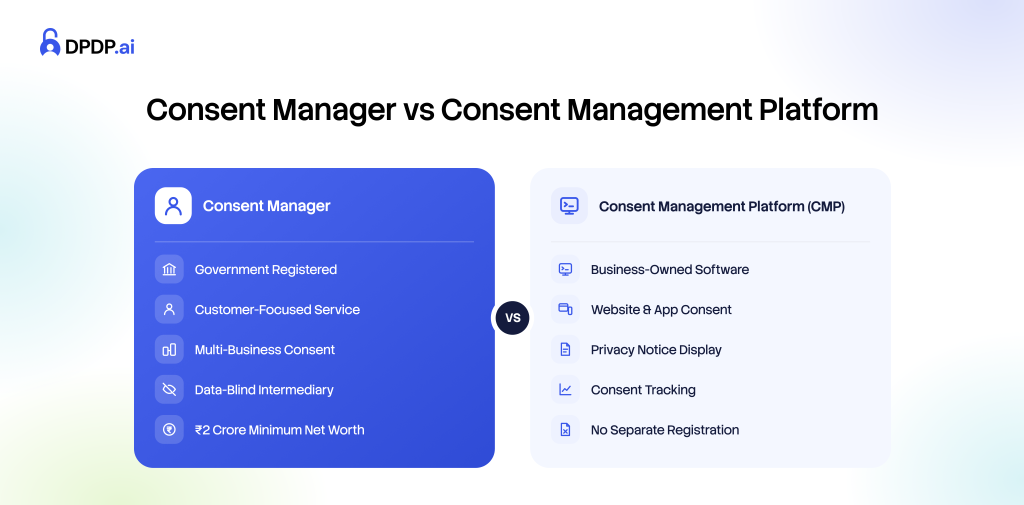
| Consent Manager | Consent Management Platforms |
| A government-registered legal entity. | A software tool installed and managed on your website and app. |
| Acts as an external bridge for customers. | Collects and tracks user permissions internally. |
| Manages broad personal data consent across multiple organizations from one dashboard. | Displays a consent banner on your site/app, enforces user choices, and stores an audit-ready record. |
| Your business only connects with it. | Your business buys and runs it daily. |
Which one Data Fudiciary need: Consent Manager & Consent Management Platform?
If your business acts as Data Fiduciary it collects customer details on a website or app, a CMP takes cares of your daily privacy rules.Use a Consent Management Platform (CMP) if you need to:
- Collect customer data from multiple sources: If you collect customer details through your website, app, and other sign-up forms, then your data gets scattered here and there. CMP helps you consolidate everything in one place and keeps track of the data collected and how you use it.
- Provide as much ease to say ‘no’ as you do for saying ‘yes’: Make sure that all your customers get an easy-to-use link for managing their privacy and contacting the data protection board.
- Provide clear notice before collecting data: A pop-up screen tells about the details and the purpose of collection.
- Keeps your proof ready if anyone audits you: As soon as you no longer require the details of your customer, the CMP will automatically flag and remove the unnecessary details so that you do not keep any data more than you have to according to the law
When should business connect with Consent Manager?
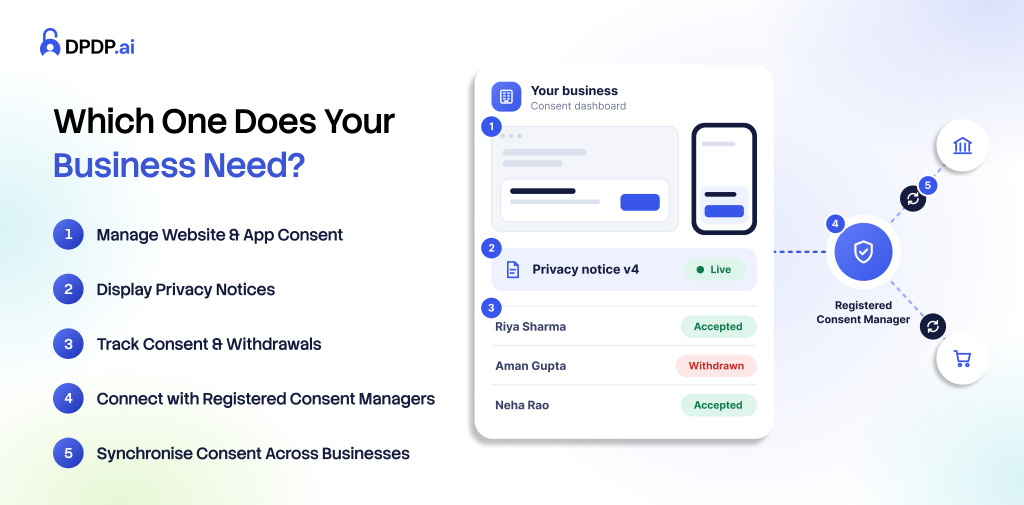
A business can work with a registered consent manager if it wants customers to manage their consent through an independent service. Connect with a Consent Manager if you want to:
- Customers get one central dashboard: Customers are able to view, modify, or revoke their consent for different brands on one single platform.
- Leverage a trusted, data-blind middleman: Permission requests are processed by the middleman who is registered with the Data Protection Board of India, ensuring that all permissions are handled securely without any personal data of the customer being visible to you.
- Get the benefit of an added trust booster: Consent Manager use by any company is optional and 100% voluntary as per the DPDP Rules, allowing you an easy way to gain more user trust.
- Ensure automatic sync of permission changes: Any modification made by the customer to their preference settings on their Consent Manager application is automatically synced to your system.
Conclusion
Under the DPDP Rules, 2025, Consent Manager registration is already live, and core compliance duties are fast approaching for every Data Fiduciary.
To handle DPDP compliance smoothly, your business actually needs both working together:
- Use a CMP on your website and apps to show clear privacy notices, record user permissions, keep proper audit logs, and handle opt-outs inside your own systems.
- Connect with a Consent Manager so your systems can easily pick up and respect any consent or withdrawal updates sent directly from the customer’s side.
FAQ
Ques: Does consent management platform need to be registered with Data Protection Board?
Ans: No, A standard CMP is simply a software tool that a business uses to manage its own compliance, so it doesn’t require registration. However, if vendors markets themselves as an official, registered Consent Manager, they should be able to provide clear proof of their registration with the Data Protection Board.
Ques: What are the conditions to register as a Consent Manager?
Ans: A consent manager must be an Indian-registered company with a minimum net worth of ₹ 2 crore. They also need trustworthy leadership with no conflicts of interest and an independently verified, secure platform to keep their customer data safe.
Ques: Does my business need to become a Consent Manager?
Ans: No, you need to become a consent manager as this role is only for specialized platforms that help users manage their permissions across multiple brands. Your business can keep collecting and managing customer consent directly on your own website or app.
Ques: How long do consent records need to be kept for DPDP audits?
Ans: A registered consent manager must keep consent records for at least 7 years under DPDP rules and use a CMP on your own site helps you store exact date and time proof of consent for your compliance audits.
Ques: What is the penalty for non-compliance under the DPDP Act?
Ans: If your business ignores consent rules or fails to update a customer’s preference on time, it can face heavy fines from the Data Protection Board – up to ₹50 crore for general mistakes, and upto to ₹250 crore for seripus data security failures.